Hierarchical Timing in Astrological Forecasting
Progressions and solar arc don't predict a specific day: they map the theme shifts between life chapters, answering 'which chapter are you in now', not 'what happens tomorrow'.
Written and reviewed in house by the AstroStarCheck research team. Astronomical positions come from the Swiss Ephemeris; interpretive rules are checked against the classical texts listed under Sources.
Orbital Mechanics and Mathematical Baselines: Progressions versus Directions
In predictive astrology, accurate timing relies on translating celestial motion into personal developmental timelines. Secondary progressions map the earth rotation on its axis to its revolution around the Sun, equating one real day of ephemeris motion after birth to one complete year of life. Because each inner planet moves at its own distinct angular velocity during those early weeks, progressed planets advance independently across the zodiac. In contrast, Solar Arc Directions, developed from Ptolemaic methods and refined by the Hamburg school and modern cosmobiology, employ a single uniform increment. The exact longitudinal distance traveled by the progressed Sun for a given age is added to every planet and angle in the natal chart. This turns the entire horoscope into a rigid geometrical framework moving forward at approximately one degree per year, eliminating individual planetary velocity discrepancies.
Psychological Maturation: The Internal Rhythm of Secondary Progressions
Secondary progressions reflect the slow unfoldment of the psyche, mirroring internal shifts in consciousness rather than abrupt external shocks. The progressed Sun advances roughly one degree annually, spending about thirty years in a single zodiac sign, representing foundational chapters in personal identity, core values, and life purpose. The progressed Moon is the swiftest indicator in this system, moving approximately thirteen degrees per year and shifting signs and houses every two and a half years. Completing its full cycle around the chart every twenty-seven to twenty-eight years, the progressed Moon closely tracks changes in emotional focus, instinctual needs, and domestic grounding. When progressed Mercury, Venus, or Mars stations retrograde or direct, individuals often experience an internal reorientation of their intellectual models, relational standards, or physical drives.
Concrete Events and Manifestation Windows: Solar Arcs and Hard Aspects
While progressions describe internal evolution, Solar Arc Directions serve as a precise clock for concrete life milestones. Formalized by Reinhold Ebertin and Noel Tyl, the solar arc diagnostic method focuses almost exclusively on the eighth-harmonic hard aspect family: conjunctions (0°), semi-squares (45°), squares (90°), sesquiquadrates (135°), and oppositions (180°). Because solar arc motion is steady, an aspect forms with an orb of no more than one degree, establishing an active window of roughly twelve to fourteen months. The highest concentration of manifestation occurs within three months of exact aspect perfection. Major career promotions, residential relocations, formal contracts, and key relationship transitions frequently coincide with solar arc directions making hard contact with natal angles or chart rulers.
Classical Chronocrators: Macro-Cycles in Firdaria and Annual Profections
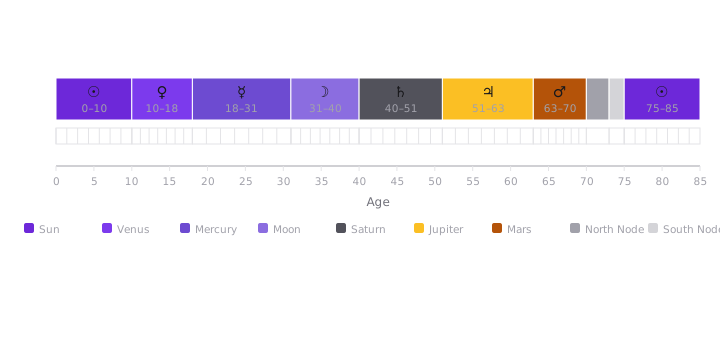
Before examining micro-triggers, practitioners must identify the reigning time lord or chronocrator. Rooted in Hellenistic and Medieval Persian traditions, Firdaria assigns fixed periods of years to traditional planets based on the diurnal or nocturnal sect of the natal chart. Annual Profections advance the ruler of the year by one house for each year of life. These classical time-lord systems establish the structural agenda and thematic governance for entire life chapters. If an individual is navigating a Saturn Firdaria major period or a Saturn profection year, the governing themes must involve structural consolidation, heightened responsibility, and enduring effort. Any simultaneous progressions or solar arcs operate strictly within the boundaries established by this overarching planetary ruler.
Real-Time Triggers: Transits as the Catalyst for Latent Potentials
Transits represent the ongoing physical positions of planets in the sky relative to the static natal chart. They span a broad spectrum of speeds: the outer planets (Pluto, Neptune, and Uranus) spend years in each sign, creating generational currents, institutional pressures, and prolonged psychological restructuring. Jupiter and Saturn operate on cycles of one and two and a half years, providing periods of social expansion and structural evaluation. Mars, Venus, Mercury, and the lunations move rapidly, acting as precision detonators. A transit rarely creates a major milestone out of nothing; instead, it delivers the final trigger for themes already ripened by progressions, solar arcs, and time lords. When transiting Mars crosses the natal Sun precisely while solar arc Midheaven squares natal Saturn, structural professional decisions manifest within days.
The Four-Tier Diagnostic Protocol: From Macro Climate to Exact Timing
Professional astrological practice avoids treating all predictive indicators as a flat list, utilizing a structured four-tier protocol instead. Tier One reviews Firdaria and profections to determine the planetary ruler and thematic territory of the year. Tier Two analyzes secondary progressions, emphasizing the house position of the progressed Moon and progression aspects, to evaluate internal readiness and emotional tone. Tier Three scans for solar arc hard aspects to natal angles and planetary configurations, assessing the probability and nature of concrete events. Tier Four monitors transiting outer planet stations and fast inner planet conjunctions to isolate the precise weeks of activation. When all four tiers highlight consistent symbolic themes, the astrological forecast achieves remarkable clarity and diagnostic value.
Diagnostic Pitfalls and False Positives: The Absolute Primacy of the Natal Promise
The most frequent error in predictive analysis is interpreting dynamic aspects in isolation from the natal chart. Classical doctrine insists on the principle of the natal promise: no event can manifest in timing systems unless its potential is clearly encoded in the birth chart. If a natal chart lacks configurations for public authority or entrepreneurial expansion, a solar arc Jupiter conjunction to the Midheaven may simply produce personal optimism or pleasant working conditions, rather than a corporate breakthrough. Conversely, if the natal chart features a tight Sun-Saturn square, subsequent activations of Saturn through progressions or transits will trigger demanding tests of endurance. Filtering out false positives requires measuring every predictive contact against the structural limits of the natal blueprint.
FAQ
What is the significance of progressed planets stationing retrograde or direct?
When an inner planet (Mercury, Venus, or Mars) stations in secondary progressions, its apparent motion slows to a standstill over several years. This represents an intense psychological turning point, causing the individual to deeply re-evaluate and internalize the intellectual, relational, or instinctual functions represented by that specific planetary archetype.
Why is True Solar Arc preferred over the mean Naibod Arc in modern calculations?
Because the Earth orbit is slightly elliptical, the Sun daily motion fluctuates between 0.95° and 1.02° per day. True Solar Arc uses the actual longitudinal distance of the progressed Sun, whereas the Naibod Arc uses an arbitrary average of 59 minutes and 8 seconds per year. True Solar Arc eliminates timing errors of several months when directing charts past age thirty.
How should an astrologer reconcile conflicting indications between a Firdaria period and a transit?
Firdaria establishes the strategic life climate and general resource availability, while transits represent tactical daily weather. If an individual is in a beneficial Jupiter Firdaria period, a harsh transiting Saturn square will manifest as constructive hard work or manageable delays rather than systemic failure, because the broader life context remains fundamentally supportive.
Why do progressed Moon crossings over the four chart angles trigger significant life shifts?
The progressed Moon focuses conscious emotional attention. Crossing the Ascendant initiates a reinvention of personal expression; reaching the Nadir (IC) deepens domestic priorities and emotional roots; crossing the Descendant activates relationship dynamics; and reaching the Midheaven (MC) brings public ambitions and career visibility to the forefront.
Why do Solar Arc practitioners focus predominantly on hard aspects rather than trines or sextiles?
Solar arc directions are designed to pinpoint externalized life events. Hard aspects (conjunctions, squares, oppositions, semi-squares, and sesquiquadrates) generate the psychological tension and objective resistance required to force decisions and tangible action. Trines and sextiles describe ease and passive flow, which rarely compel people to make radical structural changes.
Sources and further reading
Astronomical positions and interpretive rules on this page are checked against these works.
- Swiss Ephemeris (Astrodienst) (the ephemeris library behind every chart calculation)
- Firdaria (AstroWiki)
- Hellenistic astrology (historical and technical resources on Hellenistic practice)
- Ptolemy, Tetrabiblos. Loeb Classical Library, 1940. LacusCurtius, University of Chicago