Eastern Models: Wu Xing Planetary Phases, Bagua Binary Logic, and Ziwei Modular Charts
Eastern divination systems ground themselves in Five-Phase planetary periods, pure binary logic in the sixty-four hexagrams, and modulo-12 rotations in Ziwei Dou Shu.
The Planetary Foundations of Wu Xing: The Mawangdui Silk Texts
In pre-imperial and early Han China, the terms Wood, Fire, Earth, Metal, and Water functioned primarily as the designations of the five visible wandering planets: Jupiter, Mars, Saturn, Venus, and Mercury. The astrological silk manuscript discovered at Mawangdui (c. 170 BCE) provides comprehensive records of planetary ephemerides and omens. The text demonstrates that planetary synodic cycles, helical risings, retrogradations, and orbital stations were intrinsically intertwined with five-phase cosmology. This historical documentation confirms that the Five Phases originated not as detached metaphysical speculations, but as an empirical taxonomy directly tied to planetary mechanics.
Jupiter Cycles and Chaochen: The Audit Trail of Chinese Astronomy
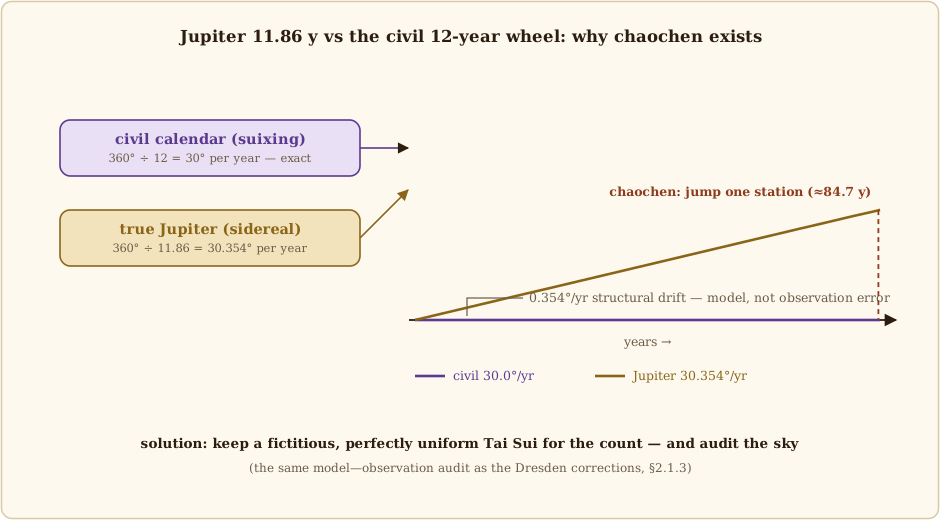
Jupiter possesses a sidereal orbital period of 11.86 years, which ancient observers rounded to twelve years to construct the system of planetary year-marking (Sui Xing). Because 11.86 does not equal 12, Jupiter progresses approximately 30.354 degrees annually rather than the calendar's nominal 30 degrees. This annual discrepancy of 0.354 degrees accumulates to an entire 30-degree zodiacal station approximately every 84.7 years. Historical chronicles including the Shiji record the implementation of Chaochen (station-skipping) corrections, wherein astronomers deliberately advanced the calendar step and introduced the fictitious uniform body Taisui to preserve computational consistency.
The Wu Xing Algebraic Theorem: The Z5 Cyclic Permutation Group
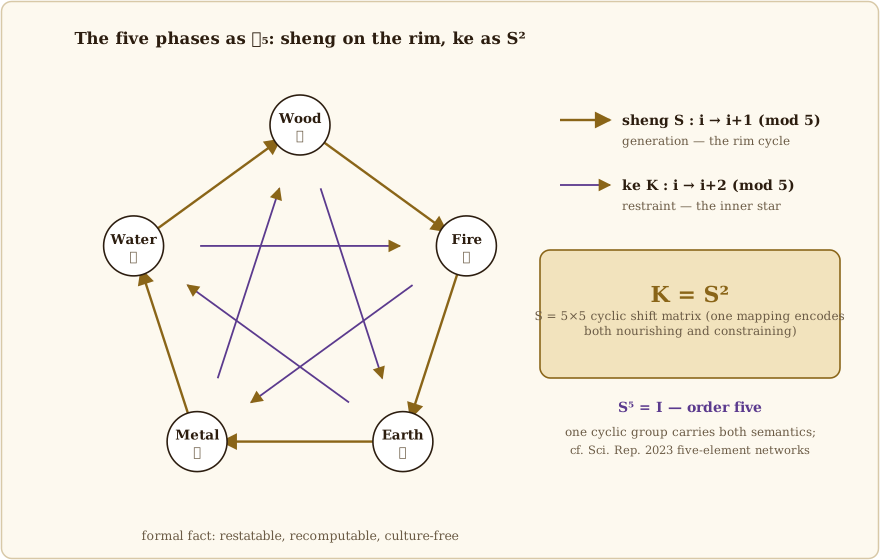
Assigning integers 0 through 4 to Wood, Fire, Earth, Metal, and Water establishes a formal algebraic structure. Generation is expressed by the cyclic shift S(i) = (i + 1) mod 5 represented as a 5x5 permutation matrix. Overcoming is governed by K(i) = (i + 2) mod 5. A fundamental algebraic theorem proves that overcoming is identical to the square of generation: K = S², with S⁵ = I (the identity matrix). This reveals that traditional Five-Phase dynamics corresponds precisely to the cyclic group of order 5 (Z5), simultaneously encoding generative and restrictive feedback mechanisms within a single closed algebraic structure.
Bagua as a Three-Bit Binary System and Shao Yong's Array
The eight trigrams (Bagua) are structurally isomorphic to a three-bit binary system, where solid Yang lines denote 1 and broken Yin lines denote 0. The classical Fuxi sequence from Qian (111) to Kun (000) corresponds exactly to a monotonic descent from 7 to 0 in decimal notation. In the eleventh century, Shao Yong structured the sixty-four hexagrams into an eight-by-eight grid: reading across each row exhibits a strictly ascending binary progression from 000 to 111 in the lower trigrams, while vertical columns descend from 111 to 000. Gottfried Wilhelm Leibniz recognized this exact alignment in 1703, confirming that hexagram configurations exhaust the state space of 2⁶ = 64 discrete binary words.
Ziwei Dou Shu: A Fully Deterministic Modular Chart Generator
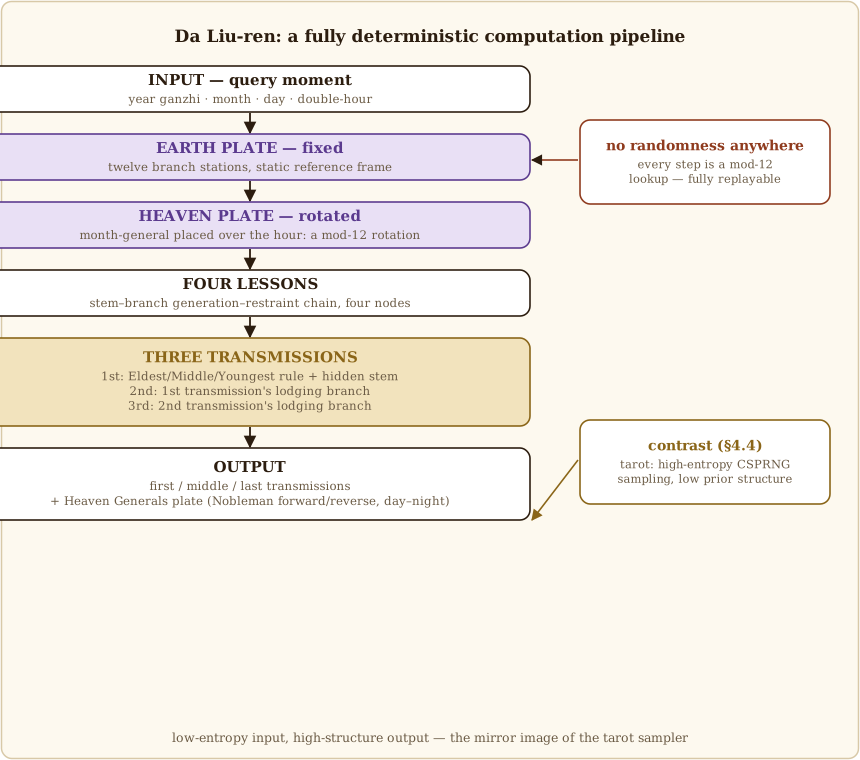
Ziwei Dou Shu represents an advanced modular state machine for natal chart construction. The procedure proceeds through six deterministic steps: executing the Five Tigers rule to establish heavenly stems across palatial sectors; consulting sexagenary Nayin tables to determine five elemental bureaus; computing the exact palace of the primary star (Ziwei) by dividing birth date integers by the bureau number; placing secondary stars via symmetric reflections; assigning forty transformation aspects across heavenly stems; and projecting lifetime transits. The system operates entirely via modular arithmetic and lookup tables without interpretive ambiguity.
Information Theory: The 720 Coarse Partition Lower Bound
A persistent historical claim asserted that Ziwei Dou Shu contains 600 coarse natal prototypes (10 stems x 5 bureaus x 12 ascendant palaces). However, number-theoretic analysis proves this calculation double-counts dependent variables, since stems and bureaus are both deterministic functions of the birth year. The mathematically correct partition space is computed by multiplying the sixty sexagenary birth years (60) by the twelve independently determined natal palaces (12), yielding exactly 720 discrete baseline charts. The framework operates as an information compressor, transforming low-entropy chronological inputs into highly structured structural outputs.
Isomorphism of Twelve Palaces Between Eastern and Western Systems
Ziwei Dou Shu partitions human experience into twelve life palaces (Destiny, Siblings, Marriage, Children, Wealth, Health, Travel, Peers, Career, Property, Virtue, Parents). This structural partition is strikingly isomorphic to the Hellenistic twelve mundane houses derived from the horizon and meridian axes. At least seven domains exhibit direct semantic and structural equivalence: Destiny to House 1, Wealth to House 2, Siblings to House 3, Property to House 4, Children to House 5, Marriage to House 7, and Career to House 10. Both civilizations independently devised identical modulo-12 topological mappings onto terrestrial life.
Folklore 3.2a: Clash with Tai Sui and Modulo-12 Jovian Projection
Chinese customs surrounding one's birth-year clash with the Guardian God Tai Sui originate in Jupiter's twelve-year orbital cycle mapped across the twelve Earthly Branches. Sharing the same branch constitutes 'governing Tai Sui', while confronting the opposing branch produces a direct clash. This mechanism is a straightforward modulo-12 projection of planetary cycles. Folk tradition subsequently personified Tai Sui into sixty military deities and invented talismanic wards, superimposing cultural narratives onto a deterministic mathematical framework.
Folklore 3.2b: Fuxi, King Wen, and the 6-Bit Binary Algebraic Space
Chinese folklore attributes the eight trigrams to mythic ruler Fuxi observing the heavens, and the sixty-four hexagrams to King Wen expanding them while imprisoned at Youli. While archaeological finds like the Mawangdui silk manuscripts reveal alternate historical sequences contrary to single-author mythologies, these origin stories do not alter the mathematical reality: sixty-four hexagrams exhaustively span a 6-bit binary state space (2⁶=64). Formal completeness stands independent of mythological origins.
Co-Authorship and Copyright Notice
This monograph is jointly researched and published by vaticinator.net & astrostarcheck.com as co-authors. All chapters, figures, mathematical derivations, and data models are protected under international copyright law. All rights reserved. No part of this publication may be reproduced, distributed, mirrored, scraped, adapted for AI training, or used commercially without express prior written authorization from the co-authors. Unauthorized reproduction will be pursued to the fullest extent of the law.
Common Questions
How does group theory validate the Five-Phase generative and restrictive cycles?
Because generation adds 1 modulo 5 and overcoming adds 2 modulo 5, the overcoming transformation is mathematically the square of the generative transformation, proving that Wu Xing forms a closed cyclic group of order 5.
What is the scientific significance of ancient Jupiter station skipping (Chaochen)?
It demonstrates that ancient astronomers did not ignore discrepancies between mathematical calendar models and empirical planetary motions, actively implementing formal reset protocols to maintain observational accuracy.
Did the I Ching directly inspire modern binary computing?
Leibniz had already formulated binary arithmetic before seeing the Fuxi diagram, but the hexagram array served as a profound historical confirmation that binary representation was an intrinsic mathematical truth.
Why is the lower bound of Ziwei charts 720 rather than 600?
Because elemental bureaus and heavenly stems are both derived from the sixty-year cycle rather than independent factors. Sixty years multiplied by twelve independent ascendant houses yields exactly 720 baseline configurations.
Does the palace isomorphism prove historical contact between China and Greece?
Not necessarily. It demonstrates that when human societies divide human existence into discrete domains, they independently converge on twelvefold modular partitions anchored in solar and planetary orbital realities.
Sources and further reading
Astronomical positions and interpretive rules on this page are checked against these works.
- Swiss Ephemeris (Astrodienst) (the ephemeris library behind every chart calculation)
- Swiss Ephemeris programmer's documentation (computation parameters and API reference)
- Introduction to the Tetrabiblos (Skyscript)
- Hellenistic astrology (historical and technical resources on Hellenistic practice)