Western Models: The Zodiac, Book T, and Discrete Samplers
Western astrology maps spherical geometry into modulo-12 houses, while Book T binds seventy-eight tarot cards to celestial coordinates as a high-entropy discrete sampler.
Zodiac Signs and House Systems: Modulo-12 Indexing in Spherical Geometry
Classical Western astrology separates celestial coordinates into two distinct duodecimal structures. Tropical zodiac signs divide the 360-degree ecliptic into twelve equal 30-degree segments, providing an absolute celestial reference frame. Mundane houses originate from local horizon and meridian circles. Whole-sign systems identify houses directly with signs, preserving pure modulo-12 rotations. Placidus systems trisect diurnal and nocturnal arcs across time. Regiomontanus projects equal divisions of the celestial equator onto the horizon. Despite divergent projection geometries, all systems yield twelve ordered domains with fixed thematic labels. Geometric disagreements alter cusp placements without altering the underlying duodecimal algebraic backbone.
Ptolemaic Houses and Thematic Domains: The Isomorphic Core Across Civilizations
Ptolemy formalized the twelve mundane house significations in the Tetrabiblos: physical life, wealth, siblings, domestic foundations, progeny, illness, partnership, death, travel, vocation, community, and seclusion. This framework exhibits structural isomorphism with Chinese Ziwei Dou Shu palaces. Seven primary domains match directly: Life, Wealth, Siblings, Property, Children, Spouse, and Career. While Western houses employ spherical geometry and Chinese charts use calendar-time modulo rotations, both construct discrete twelve-part spatial representations of human life. This formal correspondence exists as mathematical fact without requiring historical diffusion theories.
Egyptian Decans: Recursive Segmentation on the Dendera Zodiac
Ancient Egyptian astronomy demonstrates how civilizational calendars refine duodecimal frameworks recursively. Third Dynasty coffin lids record thirty-six decans dividing the sky into ten-degree intervals. Decans regulated civil time and nightly observation through thirty-six 40-minute hours, thirty-six ten-day decades, and five epagomenal days. On the Hathor temple ceiling at Dendera, thirty-six outer relief figures surround the twelve zodiac signs. The integer identity 36 = 12 × 3 provides physical proof that decanal discretization was standard astronomical technology shared between civil timekeeping and predictive charting.
Hellenistic Synthesis and Sasanian Astronomical Tables: From Alexandria to the Bundahishn
Hellenistic Alexandria synthesized Egyptian decanal observation with Greek spherical geometry. Technical Hermetica codified house computation, planetary aspects, and decanal rulerships. Sasanian Persia translated Greek and Sanskrit texts into Pahlavi, establishing zāyčag (natal horoscopy) and zīg (astronomical tables) as mathematical disciplines. Chapter five of the Bundahishn matches seven planetary deities with seven stellar constellations: Mercury (Tir) with Tishtar, Mars (Vahram) with Haptok-ring, and Jupiter (Auharmazd) with Vanand. This transmission network confirms the cross-cultural continuity of planetary-stellar coordinates.
Book T Coordinate Alignment: Complete Mapping of Seventy-Eight Cards to the Sky
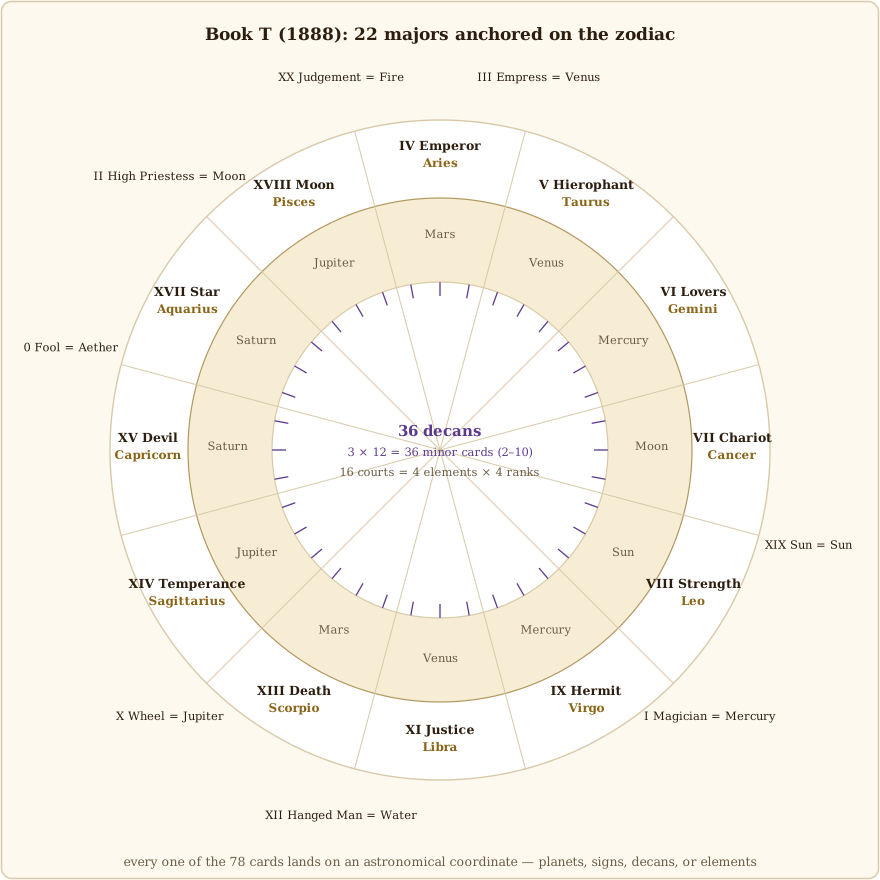
Published by Mathers in 1888, Book T established the definitive correspondence table between the 78 tarot cards and Western astrological coordinates. Twenty-two Major Arcana map to celestial bodies: the Fool to Aether, the Magician to Mercury, the High Priestess to the Moon, the Emperor to Aries, and the Tower to Mars. Thirty-six Minor pip cards (numbered two through ten across four suits) map to the thirty-six decans, binding each card to a planet and zodiac sign. Sixteen Court cards map to four elements and zodiac triplicities, while four Aces represent elemental roots. Not a single card sits outside astronomical coordinates.
Tarot as a Discrete Uniform Sampler: High-Entropy CSPRNG and Combinatorial Bounds
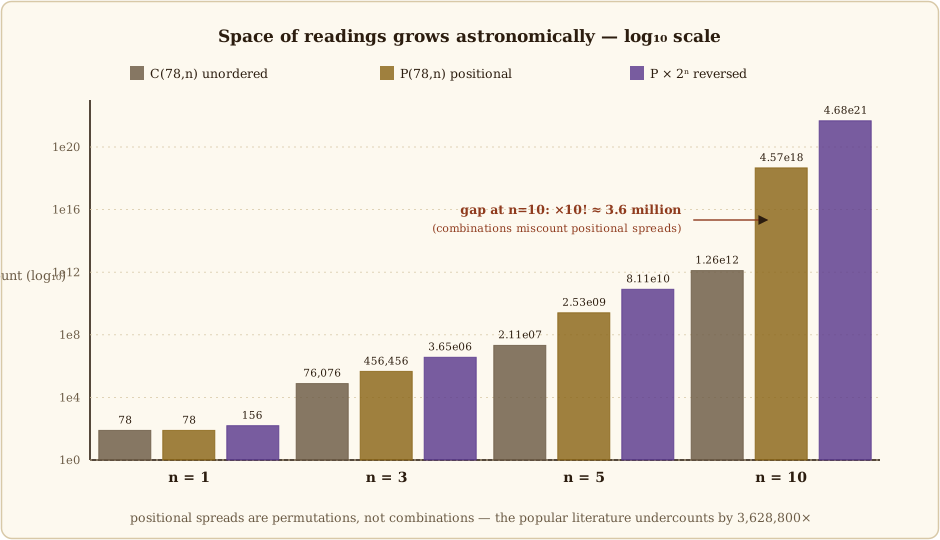
Tarot functions mathematically as a discrete uniform random sampler. Modern implementations combine the Fisher-Yates shuffle algorithm with cryptographically secure pseudorandom number generators (CSPRNG) to guarantee independent and identically distributed draws. Spread calculations must distinguish permutations P(78,n) from combinations C(78,n). Positional layouts assign specific meanings to distinct slots, requiring permutations multiplied by 2^n for orientations. In a ten-card Celtic Cross spread, positional permutations yield 4.56 × 10^18 states, reaching 4.67 × 10^21 with orientations. Treating positional spreads as combinations underestimates the true state space by 10! (3,628,800 times).
Sampling Probabilities and Empirical Audits: Streak Statistics Versus Narrative Interpolation
Daily single-card draws follow discrete uniform probability distributions. The chance of drawing the same card two days consecutively equals 1/78. Drawing yesterday's card within a seven-day window has a probability of 1 - (77/78)^7, or approximately 8.64%. Over thirty consecutive days, the expected number of unique cards drawn equals 25.04. Uniformity across large sample sets can be verified through chi-square goodness-of-fit testing. The sampling mechanism produces zero intrinsic moral meaning. All interpretive significance arises during human narrative interpolation over the discrete sample.
Folklore 4.4a: The Romani Origin Myth and Death Card Taboos
Popular superstition frequently claims tarot originated with nomadic Romani travelers arriving from the East, and treats Arcanum XIII (Death) as an omen of literal physical catastrophe. Historical records show Romani populations entered Western Europe in the 15th century, contemporaneously with Italian court playing cards, disproving an ancestral causal link. In the Golden Dawn system, Death corresponds to Scorpio, signifying cyclical transformation and seasonal renewal. Popular taboos confuse cultural folklore with a high-entropy combinatorial sampling instrument.
Co-Authorship and Copyright Notice
This monograph is jointly researched and published by vaticinator.net & astrostarcheck.com as co-authors. All chapters, figures, mathematical derivations, and data models are protected under international copyright law. All rights reserved. No part of this publication may be reproduced, distributed, mirrored, scraped, adapted for AI training, or used commercially without express prior written authorization from the co-authors. Unauthorized reproduction will be pursued to the fullest extent of the law.
Common Questions
What separates zodiac signs from astrological houses geometrically?
Zodiac signs divide the ecliptic into twelve equal 30-degree segments in celestial coordinates. Houses divide local sky space relative to the observer horizon and meridian circles.
How do Egyptian decans demonstrate recursive celestial discretization?
The Dendera ceiling depicts 36 decans encircling 12 signs. Each sign contains exactly three 10-degree decans, proving that ancient astronomers refined duodecimal divisions by tri-partition.
Why does Book T serve as formal proof of tarot celestial coordinates?
Book T maps all 78 cards systematically: 22 Major cards to signs, planets, and elements; 36 pip cards to decans; 16 court cards to elements and triplicities; leaving zero unassigned elements.
Why must positional tarot spreads be calculated with permutations P(n,k)?
Each spread position carries distinct thematic weight (such as past, present, or obstacle). Rearranging identical cards across slots produces different outcomes, requiring permutation math.
Why is algorithmic tarot defined as a discrete uniform sampler?
CSPRNG and Fisher-Yates shuffles ensure every card has an exact 1/78 selection probability. The algorithm generates uniform entropy; narrative meaning is supplied later by the interpreter.
Sources and further reading
Astronomical positions and interpretive rules on this page are checked against these works.
- Swiss Ephemeris (Astrodienst) (the ephemeris library behind every chart calculation)
- Swiss Ephemeris programmer's documentation (computation parameters and API reference)
- Introduction to the Tetrabiblos (Skyscript)
- Hellenistic astrology (historical and technical resources on Hellenistic practice)