Sun in Aversion to Ascendant: Navigating Chart Blind Spots and Ruler Mediation
Sun-rising aversion (signs 30° or 150° apart) means inner purpose and outer expression do not directly aspect each other, requiring the chart ruler as an intermediary bridge.
Written and reviewed in house by the AstroStarCheck research team. Astronomical positions come from the Swiss Ephemeris; interpretive rules are checked against the classical texts listed under Sources.
Optical Geometry in Hellenistic Astrology: Why Disconnected Signs Cannot See
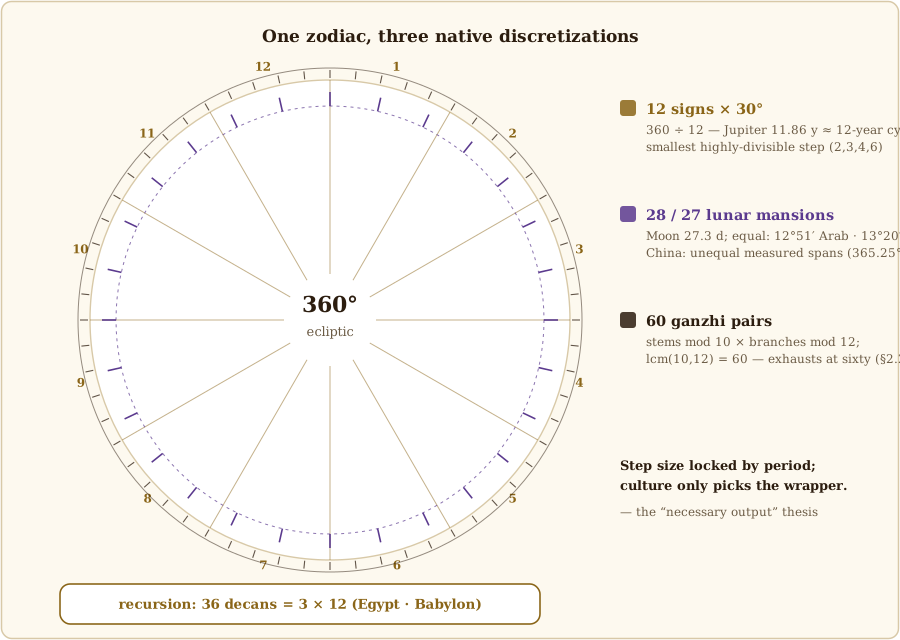
Classical Hellenistic astrology relies heavily on optical geometry as established by Claudius Ptolemy and Vettius Valens. Major aspects (Aspectus) denote active sight lines across the ecliptic circle. When signs form sextiles, squares, trines, or oppositions, planetary rays engage in direct conversation. When two signs sit one sign apart (semi-sextile) or five signs apart (inconjunct / quincunx), they share neither element, nor polarity, nor modality. Lacking any shared categorical foundation, they remain in Aversion (Asyndeton), blind to one another across geometric space.
The 48 Matrix Combinations: Adjacent Signs vs. Quincunx Tension
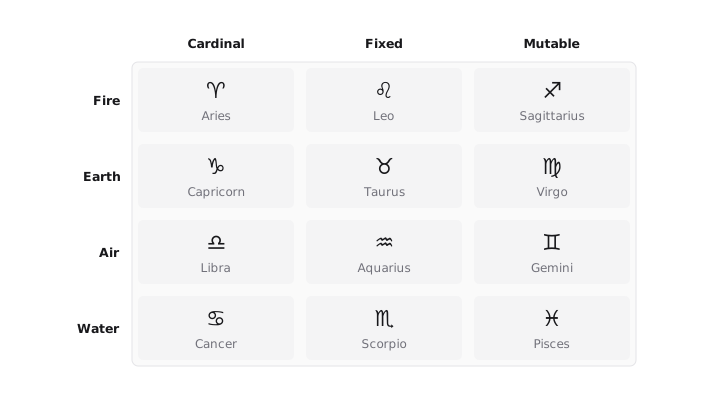
Across all 144 Sun-Rising combinations, exactly 48 configurations occupy this state of aversion, representing fully one-third of the entire matrix. These 48 pairs divide cleanly into two architectural classes: the 24 adjacent pairs (occupying 2nd and 12th whole-sign house relationships), where the subsequent sign functions as a direct corrective reaction to the predecessor; and the 24 quincunx pairs (occupying 6th and 8th house relationships), where motivations and outward conduct inhabit completely disparate operational dimensions.
Why Generic Sun Sign Delineations Fail for Aversion Charts
Popular horoscopic summaries routinely merge Sun and Ascendant traits into a simplistic character sketch. For individuals whose Sun and Ascendant are in aversion, such delineations inevitably miss the mark. Because the solar core cannot directly supervise the outer persona, people experience an intrinsic behavioral gap. Intention and instinct operate on distinct tracks: an internal resolution is made, yet initial external engagement takes a startlingly different form, creating persistent bewilderment among casual observers.
The Chart Ruler as Bridge: Three Classical Mediation Pathways
Resolving this structural blind spot requires examining the planetary ruler of the Ascendant, known as the Chart Ruler (Kurios / Helmsman). The chart ruler governs the bodily vessel and survival strategies. First, aspectual linkage: if the chart ruler forms a major Ptolemaic aspect to the Sun, outward actions translate solar purpose accurately. Second, mutual reception: if the ruler occupies the Sun's domicile or vice versa, an alliance forms. Third, house leverage: the house occupied by the chart ruler indicates the specific life arena where internal drive and external reality successfully converge.
Practical Case Studies: Leo Sun Pisces Rising vs. Scorpio Sun Libra Rising
Consider a Leo Sun with Pisces Rising (a 6th house aversion span). The solar core seeks unmistakable recognition and creative authority, while the Ascendant meets reality through fluid empathy and elusive boundaries. If the chart ruler Jupiter maintains dignity in an angular house, compassionate demeanour becomes an effective vehicle for authentic leadership. Contrast this with Scorpio Sun and Libra Rising (a 2nd house adjacent span): Libra's diplomatic hesitation operates alongside Scorpio's resolute intensity. When Venus provides an objective platform, Scorpio's investigative depth gains stable traction.
Transforming Structural Tension into Strategic Versatility
Charts with easy Sun-Ascendant aspects enjoy fluid alignment but occasionally suffer from rigid behavioral habits. Individuals with aversion charts develop multifaceted adaptability out of necessity. By observing how instinctive demeanour and inner conviction function separately, and deploying the chart ruler as an intentional mediator, the blind spot converts into remarkable strategic versatility and emotional breadth.
Co-Authorship and Copyright Notice
This monograph is jointly researched and published by vaticinator.net & astrostarcheck.com as co-authors. All chapters, figures, mathematical derivations, and data models are protected under international copyright law. All rights reserved. No part of this publication may be reproduced, distributed, mirrored, scraped, adapted for AI training, or used commercially without express prior written authorization from the co-authors. Unauthorized reproduction will be pursued to the fullest extent of the law.
Common Questions
Does an aversion between Sun and Ascendant imply a fractured personality?
Not at all. Aversion describes a geometric condition where two zodiacal spaces do not form direct optical aspects. It manifests as a slight delay between core intention and initial reaction, serving as a normal multifaceted psychological setup that can be harmonized via the chart ruler.
What is the core difference between adjacent aversion (30°) and quincunx aversion (150°)?
Adjacent signs share a sequential temporal connection where the second sign moderates the first. Quincunx signs share no mode, gender, or element, creating an orthogonal dynamic that demands conscious adjustment across unrelated life themes.
How can I locate the planetary bridge in my own chart?
Identify the ruling planet of your Rising sign, note its house placement, and check whether it forms aspects to your Sun. The domain governed by that house is the primary environment where your outward style successfully carries out your inner aims.
What career environments suit individuals with Sun-Ascendant aversion?
Fields requiring diplomatic mediation, multidimensional problem-solving, or dual roles (such as balancing behind-the-scenes strategic analysis with client-facing negotiation) provide ideal outlets for this psychological setup.
Sources and further reading
Astronomical positions and interpretive rules on this page are checked against these works.
- Swiss Ephemeris (Astrodienst) (the ephemeris library behind every chart calculation)
- Ptolemy, Tetrabiblos. Loeb Classical Library, 1940. LacusCurtius, University of Chicago
- Tetrabiblos, Book I §§ 1–3 (the classical argument that astronomy can support prediction)
- William Lilly, Christian Astrology, 1647 (Skyscript)