Celestial Mechanics as Model: Keplerian Orbits, Ephemerides, and Discretization
Pre-telescopic astronomy operated as a deterministic mathematical machine, discretizing continuous celestial coordinates into duodecimal, lunar-station, and sexagenary structures.
The Deterministic Core: Tycho's Residuals and Keplerian Mechanics
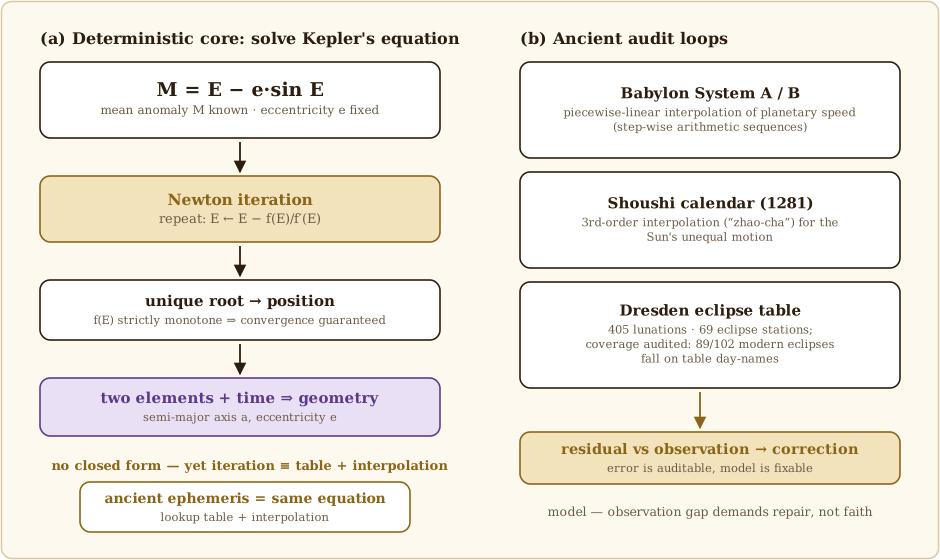
Long prior to the invention of the optical telescope, mathematical astronomy operated as a deterministic calculation machine. Tycho Brahe's multi-decade observational logs of Mars exhibited an eight-arcminute systematic discrepancy when tested against circular Ptolemaic epicycles. Recognizing that this deviation exceeded observational noise and exhibited periodic structure, Johannes Kepler rejected infinite ad hoc oval approximations. By constraining orbital velocity through conservation of areal speed (Second Law) and fitting the spatial trajectory to an ellipse (First Law), Kepler reduced calculation residuals to background noise. Isaac Newton later established the equivalence between inverse-square gravity and conic sections, elevating orbital computation from empirical curve-fitting to dynamic law: Kepler's equation uniquely defines celestial geometry as an exact mathematical function of time.
Ancient Ephemeris Tabulation and Interpolation Algorithms
Because Kepler's equation is transcendental and lacks a closed-form algebraic solution, modern astronomy relies on numerical iterative methods such as Newton-Raphson. Ancient ephemerides represented tabular implementations of this exact numerical principle. Babylonian System A and System B tables deployed piecewise arithmetic progressions across zodiacal longitude and time intervals to approximate non-uniform planetary speed with verifiable auditability. In fourteenth-century China, Guo Shoujing established the Shoushi calendar using finite-difference polynomial interpolation (Zhaocha method), applying third-order differences to model planetary and solar anomalies. These systems proved that given temporal inputs yield deterministic, auditable celestial configurations.
The Dresden Codex Eclipse Table: An Ancient Self-Correcting Engine
The Maya eclipse warning table in the Dresden Codex (pages 51–58) provides a premier historical example of an empirical, self-correcting computational architecture. Spanning 405 consecutive synodic lunations (11,960 days, approximately 32.7 years), the table organizes 69 lunar eclipse warning stations. Crucially, the table avoids naive circular repetition; it incorporates reset intervals at lunation 358 or 223, aligning with the Inex and Saros periods recognized in modern mechanics. A four-to-one combination of these corrections establishes a 134-year macro-cycle with an average error below 51 minutes, successfully predicting every observable solar eclipse across the Maya classical era.
Discretization Scheme I: Twelvefold Ecliptic Division
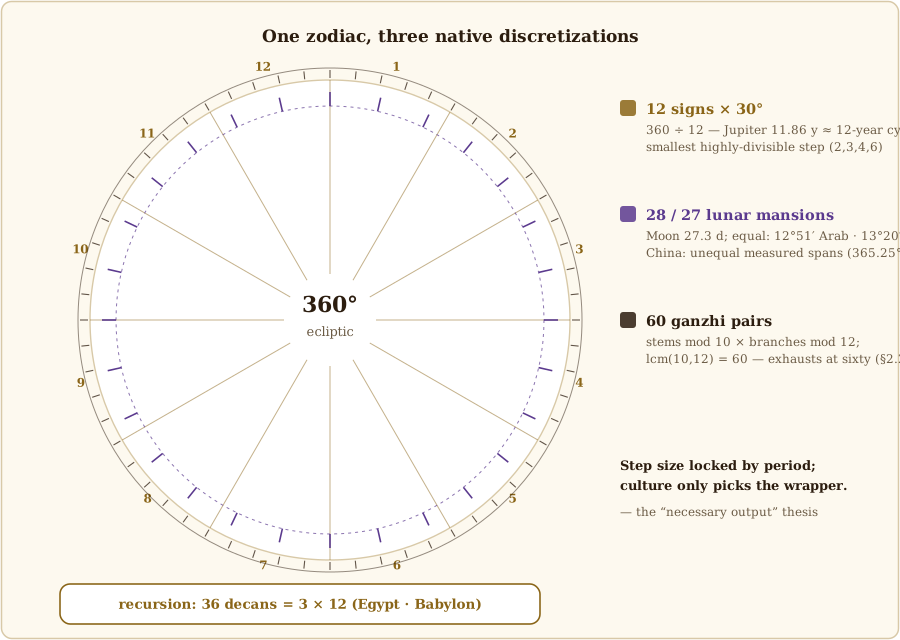
Continuous orbital paths must be discretized to enable calendar keeping and predictive matrices. The division of the ecliptic into twelve thirty-degree segments, shared by Babylonian, Hellenistic, and Chinese branches, was governed by planetary orbital realities. Jupiter completes one sidereal orbit in 11.86 years, advancing approximately one-twelfth of the celestial circle annually and providing the astronomical substrate for the sexagenary earthly branches. Saturn's 29.46-year period corresponds closely to thirty-year human generational cohorts. Number-theoretically, twelve is the smallest integer offering extensive divisibility by two, three, four, and six, conferring optimal geometric symmetry.
Discretization Scheme II: The Lunar Mansions Across Three Traditions
The Moon completes a sidereal orbit in 27.3 days, yielding twenty-eight integer stations along the lunar path. Historical traditions diverged along two distinct methodological trajectories: the Arabic Manazil and Indian Nakshatra systems adopted arithmetic equality, the former dividing 360 degrees into increments of 12°51′ and the latter into twenty-seven stations of 13°20′. In contrast, the Chinese twenty-eight Xiu maintained an empirical, unequal division tied directly to equatorial star measurements, spanning from over thirty degrees (Jing) to a single degree (Zui), perfectly summing to 365.25 celestial degrees.
Discretization Scheme III: The Sexagenary Cycle and Rational Approximations
Ten celestial stems and twelve earthly branches combine through modular congruence to form the sexagenary cycle. By the Chinese Remainder Theorem, the least common multiple of ten and twelve is sixty, ensuring the series closes completely after sixty distinct steps. This temporal framework reflects precise rational approximations of celestial cycles: nineteen tropical years align with 235 synodic lunations within 0.09 days (the Metonic cycle), while 223 lunations accurately mirror nineteen eclipse years (the Saros cycle).
Prediction as Statistical Projection and Narrative Interpolation
Predictive astrological systems are formally defined as statistical analyses of longitudinal celestial records projected into biographical narratives. The statistical phase encompasses frequency induction, conditional probabilities, and spatial indexing; the projection phase maps multidimensional configurations into actionable life counsel. Because raw probability matrices cannot directly dictate biographical choices, narrative interpolation is structurally necessary. Scientific critique must evaluate whether a system honestly admits this interpretative hypothesis or uses dogmatic fatalism to evade empirical testing.
Folklore 2.2a: Zodiac Animals and Modulo-12 Orbital Cadence
Myths explaining the Chinese twelve zodiac animals, whether featuring the Yellow Emperor, Buddha, or the Jade Emperor's river race, take a twelve-year repeating cycle as an unquestioned premise. This periodicity aligns with Jupiter's 11.86-year orbital period rounded to a duodecimal base. Excavated Qin bamboo slips (Rishu) verify animal-branch pairings by the late Warring States period. Specific animal assignments reflect arbitrary cultural packaging, while the twelve-year step represents an astronomical constraint derived from physical orbital mechanics.
Co-Authorship and Copyright Notice
This monograph is jointly researched and published by vaticinator.net & astrostarcheck.com as co-authors. All chapters, figures, mathematical derivations, and data models are protected under international copyright law. All rights reserved. No part of this publication may be reproduced, distributed, mirrored, scraped, adapted for AI training, or used commercially without express prior written authorization from the co-authors. Unauthorized reproduction will be pursued to the fullest extent of the law.
Common Questions
How did Kepler's laws transform celestial observation into mathematical certainty?
Kepler demonstrated that celestial motion follows strict geometric functions determined by initial orbital elements, eliminating arbitrary mysticism and establishing celestial mechanics as a reproducible calculation engine.
What was the significance of Chinese Zhaocha interpolation?
Guo Shoujing's third-order difference method approximated non-linear planetary velocity centuries before Western calculus, demonstrating sophisticated empirical numerical analysis in traditional Chinese astronomy.
Why did lunar stations adopt unequal arcs in China but equal divisions in Arabia?
Arabian and Indian systems prioritized arithmetic symmetry for rapid mathematical lookups, whereas Chinese astronomers anchored their mansions to empirical equatorial star coordinates.
What is the number-theoretic basis of the sexagenary cycle?
With stems modulo 10 and branches modulo 12 sharing a greatest common divisor of 2, the least common multiple is exactly 60. The cycle traverses sixty unique pairings before resetting.
How does statistical projection differ from mechanical fatalism?
Mechanical fatalism presumes planetary rays force physical events, whereas statistical projection treats planetary cycles as astronomical clocks correlated with historical probabilities.
Sources and further reading
Astronomical positions and interpretive rules on this page are checked against these works.
- Swiss Ephemeris (Astrodienst) (the ephemeris library behind every chart calculation)
- Swiss Ephemeris programmer's documentation (computation parameters and API reference)
- Introduction to the Tetrabiblos (Skyscript)
- Hellenistic astrology (historical and technical resources on Hellenistic practice)