Planetary Aspect Dynamics: Ptolemaic Aspects and Major Chart Configurations
An aspect is the angular relationship between two planets that decides whether their energies cooperate or clash: the basic grammar of chart reading.
Written and reviewed in house by the AstroStarCheck research team. Astronomical positions come from the Swiss Ephemeris; interpretive rules are checked against the classical texts listed under Sources.
Sacred Geometry and Harmonic Resonances of Aspects
In classical astronomical and astrological doctrine, the concept of aspects originates from the Latin aspectus, signifying sight or gaze. Geometrically, an aspect represents a specific angular distance formed between two or more planets along the three-hundred-and-sixty-degree circle of the ecliptic, observed from the geocentric vantage point of Earth. This theoretical architecture rests upon Pythagorean harmonic proportions and Euclidean geometry. When the circle is divided by integer fractions (two, three, four, and six), harmonic resonances emerge at angles of one hundred eighty, one hundred twenty, ninety, and sixty degrees. When two planets inhabit signs that cannot form a geometric visual line, Hellenistic practitioners classified them as disjoint or in aversion (Aversion / Asyndeton). Far from being simplistic labels of good or bad fortune, aspects represent dynamic communication corridors through which planetary archetypes negotiate, clash, and synthesize within human consciousness.
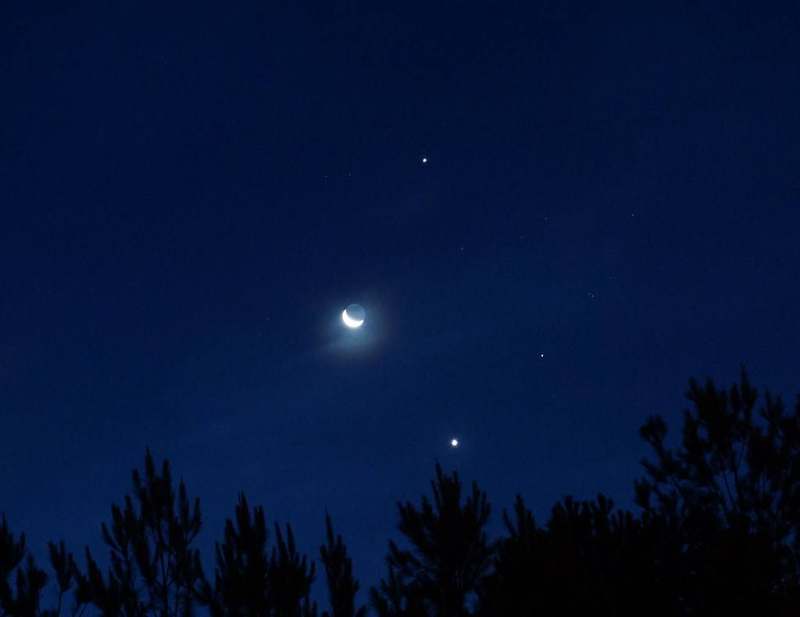
The Five Major Ptolemaic Aspects: Conjunction to Opposition
Claudius Ptolemy codified the five major aspects in his second-century work, the Tetrabiblos. The conjunction (0°) represents the primal union and fusion of two planetary forces, whose benefic or malefic quality depends entirely on the intrinsic temperaments of the participating planets. The sextile (60°), sharing the nature of Venus and the triangle, provides friendly assistance, opportunities, and cooperative pathways that require conscious initiative. The square (90°), associated with the contentious nature of Mars, generates acute friction, structural resistance, and developmental crises, serving as the strongest catalyst for tangible worldly achievement. The trine (120°), linked to the benevolent nature of Jupiter, creates effortless flow, innate talent, and protective ease. The opposition (180°), reflecting the cold polarity of Saturn, manifests as objective division, external projection, and psychological polarization, requiring conscious compromise and relational balance.
Harmonious Versus Dynamic Tension Aspects: Inertia and Growth
Popular astrology frequently reduces trines and sextiles to unreservedly positive indicators while treating squares and oppositions as purely malevolent afflictions. This binary division fails under rigorous clinical scrutiny. While harmonious aspects (trines and sextiles) bestow natural aptitude and ease, a natal chart devoid of dynamic friction often suffers from chronic inertia, leaving promising talents uncultivated due to a lack of motivating pressure. Conversely, dynamic tension aspects (squares and oppositions), though accompanied by internal conflict and worldly resistance, inject relentless ambition and driving force into the psyche. Throughout history, individuals who achieved profound creative, intellectual, or political breakthroughs possessed charts rich in intense squares and oppositions. Tension functions as the crucible of consciousness; without friction, human character rarely attains true resilience.
Applying Versus Separating Aspects: Temporal Vectors of Fate
Analyzing aspect dynamics demands rigorous attention to the relative orbital speeds and directional movement of the planets involved. When the swifter planet approaches the exact degree of an aspect with a slower planet, the aspect is classified as applying (applicatio). When the faster planet has crossed the exact degree and is moving away, the aspect is separating (separatio). An applying aspect represents an accumulating energetic charge, signifying future events, nascent psychological drives, and life lessons that have yet to reach full culmination. In contrast, a separating aspect describes ingrained habits, inherited circumstances, and concluded experiential themes. In predictive techniques and natal diagnostics, applying aspects exert a far more decisive and visible influence over the unfolding biography.
Planetary Orbs and the Doctrine of Light Radiation
Modern astrology often applies arbitrary degree boundaries to aspects regardless of the planets involved. In contrast, classical tradition adhered to the doctrine of the moiety of orbs (orbis radiorum), viewing celestial bodies as emitting physical spheres of light. In ancient astronomy, each planetary body was assigned a specific diameter of radiation: the Sun possessed an orb of fifteen degrees, the Moon twelve degrees, Jupiter and Saturn nine to ten degrees, Mars eight degrees, and Venus and Mercury seven degrees. An aspect becomes operational when the radiant fields of two planets touch and overlap. For example, when the Sun (moiety 7.5°) approaches Saturn (moiety 4.5°), the aspect begins operating within twelve degrees of separation. This optical model offers a clear visual grasp of how planetary energies engage gradually.
Combustion, Under the Beams, and the Power of Cazimi
When a planet approaches the Sun, it undergoes profound structural transformations based on proximity. A planet located within seventeen minutes of arc (0.28°) of the exact center of the Sun is in cazimi (in the heart of the Sun). Classical authors likened this state to an individual seated upon the royal throne, granting the planet immense strength, mental clarity, and elevated authority. When a planet resides between seventeen minutes and eight and a half degrees from the Sun, it is combust (combustio). Scorched by solar heat, its independent optical expression is obscured, manifesting as subjective blind spots, physical vulnerability, or suppressed agency. Between eight and a half and seventeen degrees, the planet is under the beams (sub radiis), experiencing a moderated condition of recovery.
Major Planetary Configurations: T-Squares, Grand Trines, and Yods
When multiple planets interact simultaneously through interlocking aspects, they create complex energetic networks that transcend individual placements. A Grand Trine consists of three planets in the same elemental triplicity forming an equilateral triangle of one hundred twenty-degree angles, creating closed loops of self-sufficiency and natural gift that require external stimulation to prevent stagnation. A T-Square features two planets in opposition both squaring a third focal planet (the apex), directing tremendous psychological pressure onto that single point and making it the primary vehicle for ambition and breakthrough. A Grand Cross, formed by two oppositions and four mutual squares, produces extreme environmental demands that call for exceptional organizational mastery. A Yod (Finger of Fate), composed of two sextile planets both inconjunct (150°) a focal point, indicates fateful life pivots and ongoing adjustments.
Psychological Integration of Planetary Conflicts
In contemporary analytical and archetypal astrology, aspects are understood as internal dialogues between distinct psychological complexes. Hard aspects frequently reflect fragmented sub-personalities that were split off during early development, projecting their unresolved tensions onto external relationships. Astrological maturity does not consist of predicting fortune or misfortune, but in recognizing the legitimate needs underlying conflicting planetary archetypes. By cultivating conscious awareness and creating constructive outlets for competing drives, an individual transforms sharp internal polarization into enduring creative power and psychological wholeness.
Common Questions
Why does a seemingly fortunate Grand Trine sometimes lead to lack of accomplishment?
A Grand Trine creates a closed, self-contained energetic circuit within a single element. Because energy circulates with complete ease, the individual experiences little internal distress or external resistance, often settling into comfortable complacency. Without dynamic squares, oppositions, or strong angular placements to provide motivating pressure, the native may rely on innate talent without ever undertaking the arduous discipline required for great achievement.
How should one discharge the intense pressure accumulated at the apex of a T-Square?
The apex planet of a T-Square carries the concentrated tension of the entire configuration, making it both a primary source of ambition and a focal point of anxiety. Resolving this pressure requires looking to the empty space directly opposite the apex planet (the missing leg of the cross). Cultivating the psychological virtues, habits, and activities of the sign and house in that opposing territory provides a healthy release valve that balances the apex drive.
Does a separating aspect mean that its astrological effect has completely ended?
No. A separating aspect indicates that the peak momentum of the planetary interaction has passed and its energy has shifted from an external crisis to an internalized lesson. It describes habituated behavioral patterns, instinctual assumptions, and early life conditioning. While less prone to triggering sudden external events than applying aspects, separating configurations form the foundational background of character.
How does mutual reception mitigate difficult aspects like squares or oppositions?
Mutual reception occurs when two planets occupy each other's signs of domicile (such as Venus in Scorpio and Mars in Libra). Even when connected by a harsh square or opposition, the mutual reception acts like a treaty between diplomats who disagree on policy but share common interests. This structural agreement allows the planets to exchange support, finding constructive compromises and turning potential crises into cooperative outcomes.
What practical value do minor aspects like the quincunx (150°) offer in interpretation?
Minor aspects provide valuable precision when diagnosing subtle psychological tensions and health vulnerabilities. The quincunx (inconjunct, 150°) is especially significant because it connects signs that share neither gender, element, nor quadruplicity. Operating in an instinctual blind spot, the quincunx often correlates with chronic psychosomatic adjustments, competing duties, or habits that require continuous conscious refinement.
Sources and further reading
Astronomical positions and interpretive rules on this page are checked against these works.
- Swiss Ephemeris (Astrodienst) (the ephemeris library behind every chart calculation)
- Aspects and their classical orbs (Skyscript)
- Essential dignities (Skyscript)
- Ptolemy, Tetrabiblos. Loeb Classical Library, 1940. LacusCurtius, University of Chicago