Introduction: Why Distant Civilizations Use Isomorphic Math for Fate Projection
Cross-civilizational predictive isomorphisms did not arise from chance cultural diffusion, but as inevitable mathematical outputs under a shared physical sky.
Monograph Overview and Core Abstract
Title: Astronomy as Model: Mathematical Foundations and Cross-Civilizational Corroboration of Divinatory Systems. Co-authored by vaticinator.net & astrostarcheck.com. Keywords: astronomical mathematical models, celestial sphere discretization, twelve zodiacal signs, twenty-eight lunar mansions, five planetary phases, Ziwei Dou Shu, tarot-astrology correspondence, cross-civilizational corroboration, statistical projection. Celestial motion operates as a deterministic physical machine governed by Kepler's laws. Divination models represent long-term empirical statistics projected into personal narratives. Shared mathematical structures (periods, modular arithmetic, combinatorics) explain structural convergence across Eurasia and Mesoamerica. The monograph establishes three falsifiable criteria: orbital tracking, modular isomorphism, and statistical reproducibility.
The Mathematical Convergence Across Distant Civilizations
In imperial China, the Bureau of Astronomy recorded calendars via the sexagenary cycle and cast omens across twelve terrestrial stations. In ancient Babylon, temple scribes cataloged celestial-terrestrial links across seventy cuneiform tablets of Enuma Anu Enlil. In Mesoamerica, Maya astronomers formulated 405-month eclipse warning tables. In Renaissance Europe, scholars synthesized the twelve zodiac signs and spherical quadrant house division. Separated by continents and millennia, these cultures deployed fundamentally isomorphic mathematical devices: periodic division, modular arithmetic lookup tables, and discrete state machines. This inquiry investigates whether such structural alignment reflects trans-regional cultural diffusion or the deterministic mathematical output of independent observers measuring the identical celestial sphere.
Diffusion Hypothesis Versus Deterministic Convergence
Historiographical conventions commonly favor diffusionism, tracing the zodiac from Mesopotamia across the Hellenistic Mediterranean to India and China. While cross-cultural contact occurred, diffusion alone cannot explain why disparate societies converged upon identical geometric increments. Physical constraints of the celestial sphere strictly limit optimal discretization methods: the 360-degree circle, Jupiter's 11.86-year orbital period, the Moon's 27.3-day sidereal path, and planetary synodic cycles. Isolated mathematicians seeking symmetric divisibility and orbital synchronization necessarily converge upon a restricted set of mathematical solutions.
Central Thesis: Celestial Dynamics as a Mathematical Engine
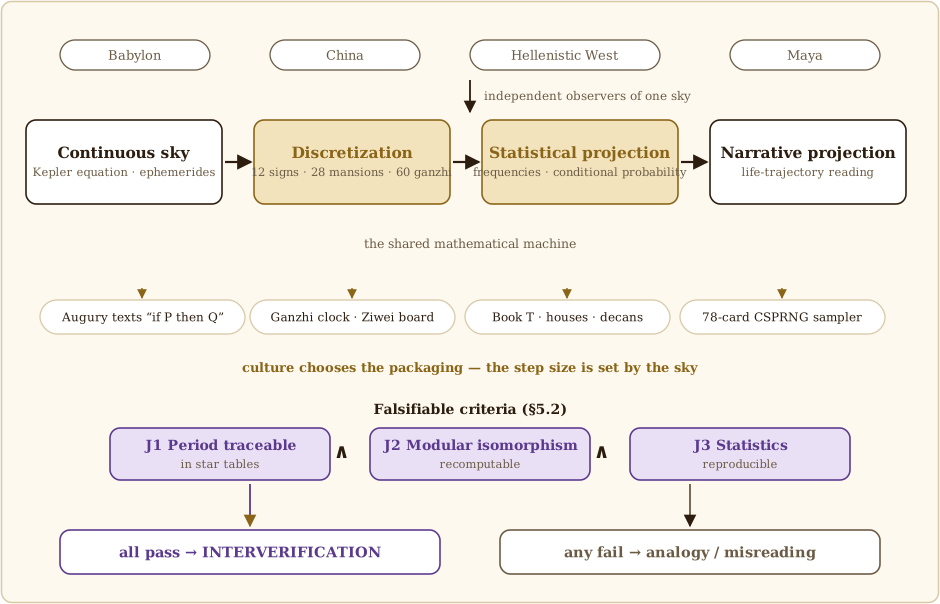
Orbital mechanics operates as a deterministic computational engine: Kepler's laws govern planetary trajectories, and ephemerides render them into auditable spatial matrices. Divinatory frameworks represent statistical summaries of these empirical records, projected into biographical narratives. Eastern traditions built upon Wu Xing planetary phases, Bagua binary logic, and Ziwei Dou Shu modular charts, while Western methods established twelve-house spherical geometry, Egyptian decanic divisions, and tarot discrete combinatorial sampling. Far from incommensurable mystical intuitions, both traditions share an identical mathematical substrate of periodicity, modular tables, and combinatorial spaces.
Three Falsifiable Criteria for Cross-Civilization Corroboration
Distinguishing mathematical corroboration from ungrounded mysticism requires explicit, falsifiable standards. This research establishes three criteria: documented orbital periodicity (J1), verifiable modular isomorphism (J2), and reproducible statistical methodology (J3). Orbital periodicity requires every interval to map onto astronomical ephemerides. Modular isomorphism requires permutation rules, cyclic shifts, and table lookups to permit exact independent recalculation. Reproducible statistics mandates pre-registered protocols with measurable effect sizes. Failure on any criterion downgrades a claim to mere formal analogy.
The Epistemic Asymmetry of Structural and Empirical Criteria
The three criteria are structurally asymmetric: the first two serve as non-negotiable structural requirements, while the third represents an empirical test. Orbital cycles and modular algorithms are a priori mathematical properties verifiable through ephemeris data and historical texts without empirical sampling error. Statistical testing is a posteriori and subject to sample size and power constraints. Prioritizing deterministic structural criteria prevents post hoc rationalization and ensures cross-civilization comparisons maintain strict deductive rigor.
Statistical Projections and Narrative Interpolation
Empirical analysis yields multidimensional conditional probability tables and frequency distributions that cannot produce singular biographical counsel on their own. Compressing high-dimensional matrices into a linear practical recommendation necessitates narrative interpolation. The boundary between serious analytical systems and fatalistic superstition lies in acknowledging this interpretative step. Auditable systems acknowledge the synthetic nature of narrative interpretation and maintain error-correction logs; unauditable systems deny interpolation and rely on ambiguous rhetoric to evade falsification.
Structural Outline of the Monograph
This monograph proceeds through six progressive chapters: Chapter 2 establishes the celestial deterministic engine and discretization schemes; Chapter 3 analyzes Eastern mathematical frameworks including Wu Xing and Ziwei Dou Shu; Chapter 4 examines Western house geometries, Book T correspondences, and tarot sampling spaces; Chapter 5 compiles the master isomorphism inventory, tests the three criteria, and reports a yoked double-blind experiment; Chapter 6 concludes by defining the historical lineage and honest boundaries of predictive frameworks.
Co-Authorship and Copyright Notice
This monograph is jointly researched and published by vaticinator.net & astrostarcheck.com as co-authors. All chapters, figures, mathematical derivations, and data models are protected under international copyright law. All rights reserved. No part of this publication may be reproduced, distributed, mirrored, scraped, adapted for AI training, or used commercially without express prior written authorization from the co-authors. Unauthorized reproduction will be pursued to the fullest extent of the law.
Common Questions
Why is cross-civilization structural isomorphism not considered a coincidence?
Astronomical observation imposes inescapable physical bounds. Jupiter's 11.86-year orbital period locks both Chinese earthly branches and Mediterranean zodiac cycles, while the Moon's 27.3-day transit locks twenty-eight lunar stations. Twelve is the smallest integer offering extensive divisibility by two, three, four, and six, making identical discretization mathematically inevitable.
How do the three falsifiable criteria eliminate mystical projection?
Superficial mystical comparisons rely on arbitrary associative claims. This framework enforces strict rules: if an astronomical period cannot be confirmed in ephemerides or an algorithm cannot be independently recalculated, the claim is rejected. Substantive corroboration demands both structural verification and statistical accountability.
What is narrative interpolation in predictive systems?
Mathematical and statistical models output high-dimensional probability fields rather than singular life outcomes. Translating these matrices into practical human guidance requires an analyst to select, prioritize, and articulate a coherent path, a process termed narrative interpolation.
Why are Babylonian omens and Leibniz's I Ching analysis treated as footnotes?
Babylonian omens displayed formal discipline but conflated correlation with mechanical causation. Leibniz recognized binary isomorphism in the Fuxi diagram but lacked historical operational continuity with Chinese divination methods. Failing full criteria satisfaction, both serve as informative boundary cases.
Does this monograph endorse literal astrology or fortune-telling?
No. The monograph demonstrates that ancient divination frameworks functioned as empirical statistical projections of celestial mathematical models. It honors the ingenuity of historic mathematical architectures while explicitly defining the limits of empirical inference and rejecting fatalistic dogmatism.
Sources and further reading
Astronomical positions and interpretive rules on this page are checked against these works.
- Swiss Ephemeris (Astrodienst) (the ephemeris library behind every chart calculation)
- Swiss Ephemeris programmer's documentation (computation parameters and API reference)
- Introduction to the Tetrabiblos (Skyscript)
- Hellenistic astrology (historical and technical resources on Hellenistic practice)