Cross-Civilizational Corroboration: Isomorphisms, Criteria, and Yoked Experiments
Divination systems across cultures must withstand three falsifiable criteria: orbital period tracking, algebraic isomorphism, and empirical reproducibility.
Five Formal Isomorphisms: Structural Invariants in Pre-Telescopic Divination
Comparative analysis identifies five exact mathematical isomorphisms across Eurasian predictive models. First, the Twelve-to-Twelve correspondence aligns Western tropical houses with Chinese Ziwei palaces through shared modulo-12 indexing, displaying identical definitions across seven core domains: Life, Wealth, Siblings, Real Estate, Children, Spouse, and Career. Second, Chinese xiu, Indian nakshatra, and Arab manazil systems lock their station intervals to the 27.3-day sidereal lunar period regardless of observational starting points. Third, the five visible planets anchor five-phase cyclical algebra, with Jupiter's 11.86-year orbit fixing the twelve-part earthly branches. Fourth, sixty-four I Ching hexagrams factor into pure binary recursion (2^6), while seventy-eight tarot cards incorporate prime factors 3 and 13 to classify celestial and elemental coordinates. Fifth, binary decision formalisms span Babylonian omens, Fuxi hexagram diagrams, and tarot card orientations.
Three Falsifiable Criteria: Distinguishing Rigorous Corroboration from Superficial Analogy
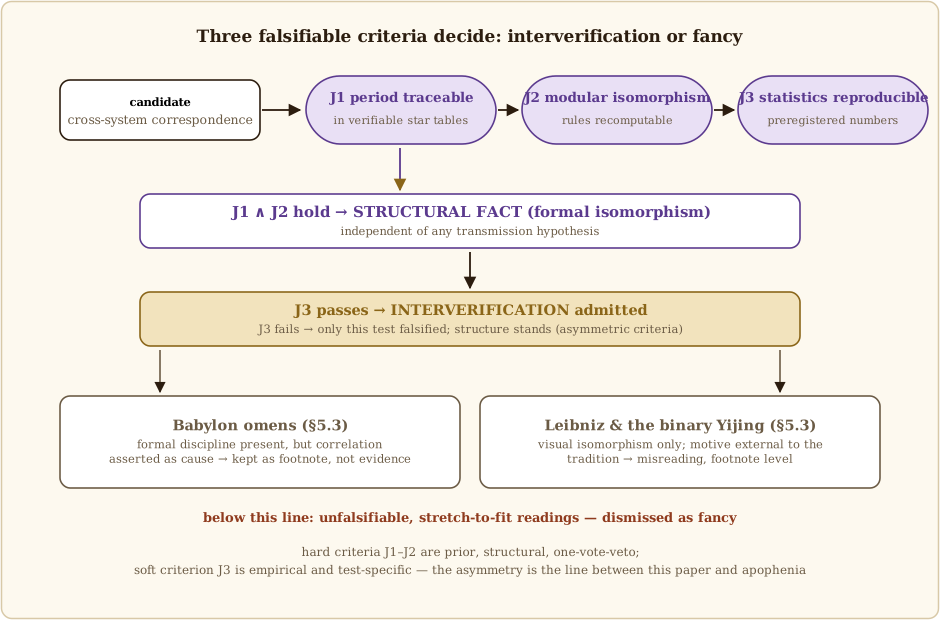
Comparative structural analysis requires objective falsification protocols to prevent arbitrary mystical claims. Criterion 1 requires astronomical period alignment (J1): time constants must match ephemerides precisely; arbitrary temporal cycles fail automatically. Criterion 2 requires modular algebraic verification (J2): permutations, rotations, and table-lookup algorithms must be independently reproducible by mathematicians; divergent modulo equations or group transformations disqualify the candidate. Criterion 3 requires statistical reproducibility (J3): systems must provide preregistered, third-party recalculable quantitative data, exemplified by Maya eclipse resets in the Dresden Codex; null empirical findings falsify individual hypotheses.
Logical Division Between Hard and Soft Criteria: Veto Powers and Empirical Limits
The three criteria operate under epistemic asymmetry. J1 and J2 serve as structural hard criteria: whether orbital periods match and whether algebraic structures are isomorphic are mathematical and physical facts holding absolute veto power. If either fails, the candidate falls to superficial cultural analogy. J3 serves as an empirical soft criterion: empirical effect sizes fluctuate with sample size and observational noise. A null statistical test disproves only that specific empirical reading without collapsing previously demonstrated algebraic isomorphisms. This demarcation shields structural inquiry from subjective mysticism.
Counterexample Demotion I: Babylonian Omens and the Fallacy of Causal Conflation
Tablet 56 of the Enūma Anu Enlil in the British Museum provides canonical examples of Mesopotamian astral divination. Inscriptions record strict conditional clauses: if a planet enters the interior of the Moon, a deity devours the land; if a planet stands at the Moon's right horn, famine strikes Amurru. While fulfilling formal conditional logic (If P then Q), this system mistakes temporal correlation for causal determination. Babylonian omens articulated no dynamical equations or physical mechanisms. Consequently, they cannot join the primary corroboration register, remaining demoted as cautionary examples of correlational bias.
Counterexample Demotion II: The Leibniz Binary Hexagram Misattribution
Gottfried Wilhelm Leibniz discovered binary arithmetic parallels in the Shao Yong circular hexagram chart sent by Joachim Bouvet. Despite remarkable visual isomorphism, the case fails strict corroboration standards. Leibniz's positional notation shared zero genealogical transmission with ancient Chinese yarrow-stalk divination algorithms (failing J1). No historic Chinese texts ever executed binary algebraic calculations to derive and reverse hexagram sequences (failing J2). Leibniz advanced the comparison to further his universal language project and Christian theology. The case remains classified as an inspiring cross-cultural misreading.
Chinese Almanac Deconstruction: Separating Modulo-12 Logic from Folk Mythologies
Traditional Chinese almanacs (Huangli) embody the co-existence of mathematical order and folk mythology. The twelve Jianchu day officers (Establish, Remove, Full, Balance, Settle, Grasp, Break, Danger, Complete, Receive, Open, Close) represent modulo-12 rotations of the monthly branch projected along solar coordinates. In popular dissemination, however, folkloric superstitions like Sanniang Sha and Yanggong Ji superimposed arbitrary prohibitions without astronomical basis. Structural analysis distinguishes these layers: verifiable modular arithmetic represents valid celestial modeling, while unfalsifiable taboos belong to folkloric accretion.
Preregistered Yoked Experimental Design: Testing Interpretive Invariance Across Systems
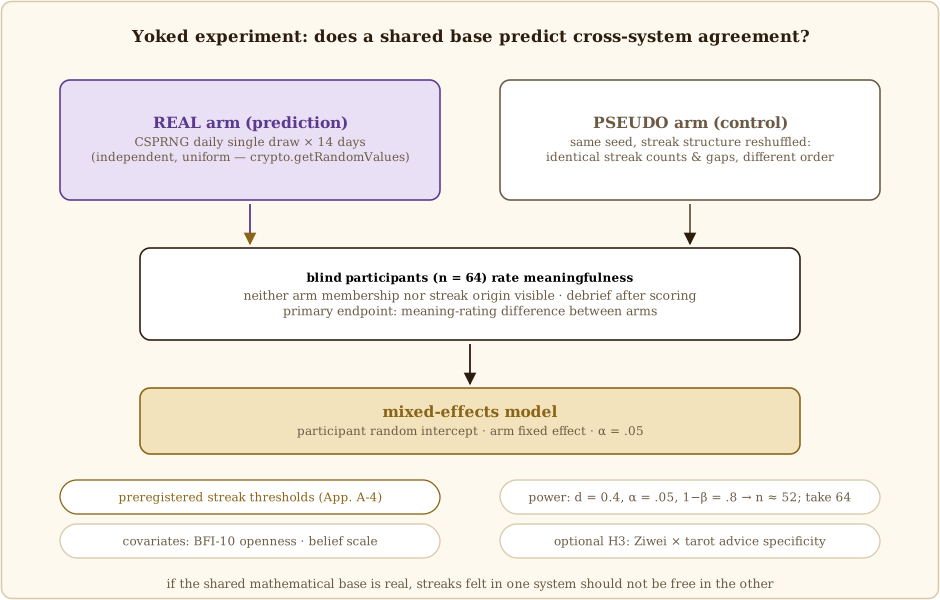
To evaluate interpretive consistency empirically, this study implements a double-blind yoked experimental protocol. With sample size n=64, alpha=.05, and statistical power at .80, the true arm generates daily single cards over fourteen consecutive days via cryptographically secure pseudorandom generators (CSPRNG). The yoked control arm uses the same random seed while permuting temporal order, preserving streak frequencies. Covariates include the Big Five Openness scale and Tobacyk's Revised Paranormal Belief Scale (RPBS), evaluated through linear mixed-effects models. A secondary hypothesis (H3) examines specificity correlations between Ziwei career readings and tarot spreads. Preregistered on the Open Science Framework (OSF), all classification thresholds remain immutable.
Folklore 5.3c: Traditional Almanacs, Jianchu Spirits, and Modulo-12 Rhythms
Traditional Chinese almanacs (Huangli) demarcate auspicious and inauspicious activities for each day. Their mathematical core, the Twelve Jianchu Spirits (Establish, Remove, Full, Balance, etc.), represents a modulo-12 rotation linked to monthly solar terms and lunar phases. While ancient astronomers used this framework for empirical agricultural observation, subsequent folk superstition overlaid arbitrary taboos like Yanggong Ji and Sanniang Sha. Scientific corroboration isolates the deterministic modular cycle while discarding unfalsifiable folkloric taboos.
Co-Authorship and Copyright Notice
This monograph is jointly researched and published by vaticinator.net & astrostarcheck.com as co-authors. All chapters, figures, mathematical derivations, and data models are protected under international copyright law. All rights reserved. No part of this publication may be reproduced, distributed, mirrored, scraped, adapted for AI training, or used commercially without express prior written authorization from the co-authors. Unauthorized reproduction will be pursued to the fullest extent of the law.
Common Questions
Why is the correspondence between Western and Ziwei houses classified as corroboration rather than coincidence?
Both models apply modulo-12 spatial rotations to human affairs, overlapping across seven core domains (Life, Wealth, Siblings, Property, Children, Spouse, Career), constrained by Jupiter's orbital cycle.
Why do J1 and J2 serve as non-negotiable hard criteria?
Period alignment (J1) and algebraic isomorphism (J2) represent objective mathematical and physical facts independent of human subjectivity. Structural failure collapses the scientific foundation.
Why is Leibniz's binary interpretation of hexagrams classified as analogy rather than corroboration?
Yarrow stalk casting and positional binary math share no historical genealogy, and no ancient texts performed reversible binary arithmetic on hexagrams. It remains a visual misreading.
Why are Babylonian Enūma Anu Enlil omens excluded from the core corroboration list?
While satisfying conditional logic syntactically, they substitute empirical correlation for mechanical causation without physical intermediaries, demonstrating the fallacy of false cause.
How does the yoked experimental design eliminate psychological bias?
The control arm shares the exact streak frequencies and cards as the experimental arm, differing only in sequence. Double-blind scoring prevents confirmation bias from inflating statistical significance.
Sources and further reading
Astronomical positions and interpretive rules on this page are checked against these works.
- Swiss Ephemeris (Astrodienst) (the ephemeris library behind every chart calculation)
- Swiss Ephemeris programmer's documentation (computation parameters and API reference)
- Introduction to the Tetrabiblos (Skyscript)
- Hellenistic astrology (historical and technical resources on Hellenistic practice)