What Retrograde Actually Is
Retrograde isn't a planet moving backwards: it's an optical effect from Earth's viewpoint; astrologically it usually signals slowing down, reviewing and double-checking that area.
Written and reviewed in house by the AstroStarCheck research team. Astronomical positions come from the Swiss Ephemeris; interpretive rules are checked against the classical texts listed under Sources.
Retrograde Is a Line-of-Sight Illusion
When a planet appears to move backward in the sky, it is not reversing its orbit. Earth and the outer planet are like two runners on different tracks. As Earth overtakes Mars or Saturn, the other planet seems to drift westward against the stars. That geometric projection is retrograde.
Why Each Planet Has Its Own Retrograde Rhythm
Mercury and Venus retrograde every few months because they orbit closer to the Sun, and their synodic cycles are short. Mars retrogrades about every 26 months, lasting longer. Jupiter and Saturn slow down annually for about four months. The farther and slower the planet, the rarer but longer the apparent backward dance.
The Historical Theme of Review and Revisiting
Ancient astrologers noticed that during retrograde, the planet's usual forward expressions turn inward. Mercury's review of communication, Venus's revisit of values, Mars's reassessment of action. The word 'retrograde' also means 'to go backward' in Latin, and the practice has always been to pause, correct, and refine rather than to push ahead blindly.
Reading the Retrograde Calendar
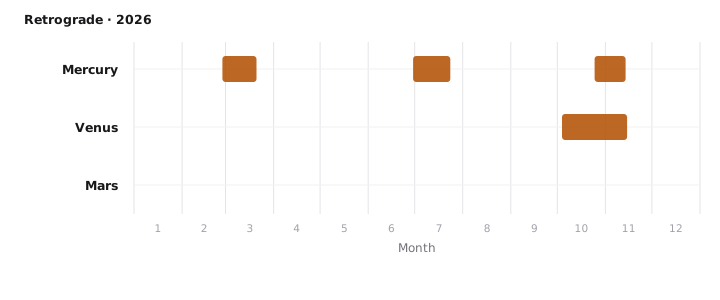
Look at the annual calendar as a map of natural slow-downs. Each shaded block marks a window where starting new projects in that planet's domain is less favorable. Instead, use those weeks for planning, editing, and completing. Note that Mercury's three to four retrogrades each year are the most commonly cited, but all planets have their own seasons.
Practical Use Without Fear: Three Steps
First, identify which planet is retrograde and what life areas it rules. Second, list unfinished tasks tied to that domain, like overdue emails for Mercury or unresolved negotiations for Venus. Third, schedule deliberate reviews during the window. Avoid signing major contracts or launching campaigns exactly on the retrograde's shadow dates, but do not cancel your life.
When Retrograde Ends: The Post-Shadow Period
After the planet turns direct, it still travels through the same degrees where it was retrograde. This is called the shadow phase. For Mercury it lasts about two weeks; for outer planets longer. Treat this as the return to normal speed. Implement lessons learned during the retrograde, and finalize decisions once the planet has cleared its shadow.
FAQ
Does retrograde actually mean the planet moves backward in space?
No. In space, the planet always moves forward in its elliptical orbit. The backward motion is an apparent shift caused by Earth's relative speed and position. It is similar to seeing a slower car appear to reverse when you overtake it on a highway.
Why do people say to avoid starting new things during Mercury retrograde?
Mercury rules communication, travel, and contracts. During its retrograde, these areas tend to have more delays, miscommunications, and technical glitches. Astrologers advise double-checking details, backing up files, and reviewing plans rather than launching fresh initiatives that may need rework.
How do I find the retrograde dates for each planet?
Use an ephemeris or a reliable astrology app. AstroStarCheck's annual calendar lists the start and end dates, plus the shadow periods. It also shows the zodiac sign and degrees. For beginners, start with Mercury, then add Venus and Mars once you are comfortable with the rhythm.
Can I still make important decisions during retrograde?
Yes, but with extra care. Retrograde is not a curse; it is a natural time for internal review. You can make decisions if you have done thorough research and have backup plans. Avoid impulsive choices and major long-term commitments unless you can easily revise them later.
Sources and further reading
Astronomical positions and interpretive rules on this page are checked against these works.
- Swiss Ephemeris (Astrodienst) (the ephemeris library behind every chart calculation)
- Swiss Ephemeris programmer's documentation (computation parameters and API reference)
- NASA Science, Solar System
- Ptolemy, Tetrabiblos. Loeb Classical Library, 1940. LacusCurtius, University of Chicago