Transits vs Progressions: What's the Difference

Transits are the planets' current positions affecting you; progressions are your chart's inner evolution: one external, one internal.
Key Dimensions Comparison
| Dimension | Transits | Progressions |
|---|---|---|
| What it is | The planets' real current positions interacting with your natal chart. | Advancing one day after birth as a year, showing inner evolution of the planets. |
| What it answers | 'What outside is influencing me now?' | 'What inner phase am I going through?' |
| Time scale | Real-time; from hours to days and months. | Slow; theme shifts measured in years. |
| Astronomical Mechanics | Current real-time planetary ephemeris positions | One ephemeris solar day after birth equated to one calendar year of life |
| Interpretive Level | Calculates hard aspects from transiting outer planets to natal angles and luminaries | Tracks progressed Moon sign/house ingresses and major progressed Sun aspects |
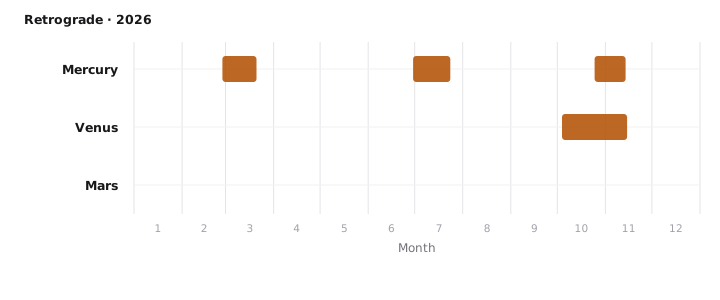
| How to use it | Short-term events and timing: new moons, full moons, retrogrades, sign changes. | Life-phase atmosphere: the inner growth arc. |
| Common Pitfalls | Panicking over isolated daily transits without checking progressed background maturity | Getting lost in internal progression symbolism while ignoring concrete worldly limitations |
| How they relate | Used together: transits trigger, progressions set the background: richer combined. | Transits act fast and visible; progressions slow and lasting. |
Classical Lineage & Theoretical Genesis
Ptolemy and medieval Islamic astrologers developed primary directions and profections, while 17th-century monk Placidus de Titis formalized secondary progressions grounded in the biblical day-for-a-year formula. Contemporary predictive astrology designates external transits as environmental catalysts, while progressions represent internal organic psychological readiness.
Celestial Coordinates & Astronomical Mechanics
Transits calculate exact current ephemeris coordinates against the natal radix: outer planets move slowly across years, while inner planets move swiftly. Secondary progressions advance natal positions by assigning one solar day after birth to one calendar year of life: the progressed Moon moves roughly 1 degree per month, marking major psychological chapter shifts.
Diagnostic Chart Case Study
Consider a native whose progressed Moon ingresses into Aries in the 1st house, igniting an intense urge for independent entrepreneurship. Concurrently, transit Saturn forms an exact opposition to the natal Sun, imposing capital constraints and regulatory hurdles. The synthesis indicates internal readiness for autonomy, but external reality demands disciplined risk management and patience.
Practical Synthesis and Reading Tips
Follow the interpretive hierarchy: progressions set the internal season; transits trigger the external weather. Identify whether your secondary progressions reflect an expansionary or consolidation phase first, then observe transiting aspects to pinpoint exact manifestation windows.
Life Context and Self-Awareness
When external obstacles arise, ask whether your internal maturity is ready to support the next level of responsibility. When life appears smooth externally yet feels stagnant inside, look to your progressions to discover where your soul seeks renewal.