Natal Chart vs Solar Return: What's the Difference

The natal chart is your lifelong baseline; the solar return is a fresh yearly chart drawn each birthday: one covers everything, one covers the year.
Key Dimensions Comparison
| Dimension | Natal Chart | Solar Return |
|---|---|---|
| What it is | The chart of the moment you were born: fixed for life. | The chart of the moment the Sun returns to its birth place each year: one per year. |
| What it answers | 'What are my lifelong themes?' | 'What should I focus on this year?' |
| Time scale | Spans a lifetime. | Spans one year, from birthday to birthday. |
| Astronomical Mechanics | Permanent lifetime chart fixed by birth timestamp and coordinates | Annual chart cast for the exact moment the transiting Sun meets the natal Sun degree |
| Interpretive Level | Evaluates core personality, innate gifts, and lifetime architecture | Overlays the Return Ascendant and stelliums onto corresponding natal houses |
| How to use it | For personality, talents and lifelong themes. | For the year's themes, opportunities and watch-outs. |
| Common Pitfalls | Reading the Solar Return in isolation and fabricating detached predictions | Believing relocation for a birthday eliminates inherent natal challenges |
| How they relate | Complementary: the solar return is a yearly snapshot read against the natal background. | A new one is drawn each birthday, so yearly themes differ. |
Classical Lineage & Theoretical Genesis
Medieval Persian scholar Abu Ma'shar in On the Revolutions of the Years of Nativities formalized the Tahwil solar return technique. English master William Lilly in Christian Astrology emphasized that a solar return chart must never be interpreted in isolation; it functions strictly as an annual activation overlay upon the natal radix.
Celestial Coordinates & Astronomical Mechanics
The natal chart permanently anchors the planetary positions and horizon axes at birth. The Solar Return chart calculates the precise second each year when the transiting Sun returns to the exact zodiacal degree, minute, and second of the natal Sun, casting a new Ascendant and twelve houses for the native's current geographical location.
Diagnostic Chart Case Study
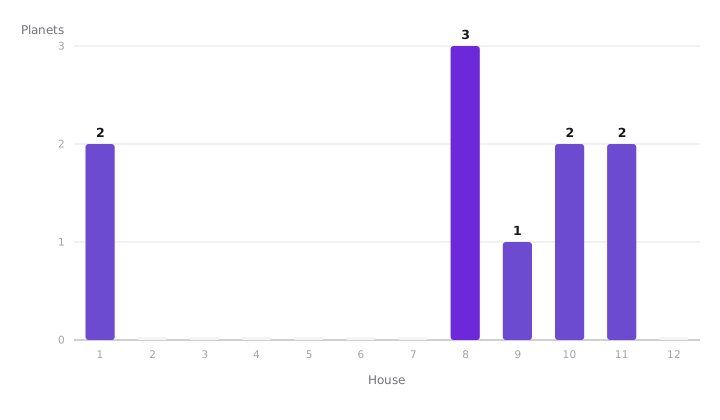
Suppose a native has a stable 2nd house in the natal chart. In a particular year, the Solar Return Ascendant falls into the natal 8th house, while Solar Return Jupiter and Saturn occupy the Return 10th house. That year's primary narrative centers on career advancement tied to shared equity, institutional loans, or tax restructuring. The Solar Return reveals where the spotlight falls; the natal chart determines the capacity to sustain the pressure.
Practical Synthesis and Reading Tips
Never delineate a Solar Return in a vacuum. First, identify which natal house the Solar Return Ascendant overlays to pinpoint the focal life area. Second, inspect aspects and receptions between the Return Ascendant ruler and natal planets. Third, cross-reference with planetary transits to identify activation timing.
Life Context and Self-Awareness
Reviewing your Solar Return around each birthday offers clarity on when to press forward and when to consolidate. In years that emphasize internal grounding, avoid forced expansion; in years signaling breakthrough, move decisively without hesitation.