Western vs Vedic Astrology: What's the Difference

The biggest difference is the zodiac: Western uses the tropical system with the seasons, Vedic the sidereal with the stars: signs can differ by one.
Key Dimensions Comparison
| Dimension | Western | Vedic |
|---|---|---|
| What it is | Tropical zodiac from the vernal equinox; follows the seasons. | Sidereal zodiac from fixed stars; follows the sky. |
| What it answers | 'What is the seasonal energy?' | 'Where was I among the actual stars?' |
| Time scale | Anchored to the equinox; drifts with precession. | Anchored to stars; nearly fixed. |
| Astronomical Mechanics | Seasonal Tropical zodiac coordinates with major Ptolemaic aspect geometry | Sidereal stellar zodiac offset by ~24° Ayanamsha, integrating 27 Nakshatras |
| Interpretive Level | Jungian archetypal projection, modern outer planets, and asteroids | Parashari classical framework, divisional Vargas, Dashas, and remedial Upayas |
| How to use it | Default for most apps and popular horoscopes. | Mainstream in Indian tradition; Moon and divisional charts matter a lot. |
| Common Pitfalls | Using psychological rationalizations to excuse inaction or ignore worldly realities | Succumbing to rigid fatalism that extinguishes constructive personal agency |
| How they relate | Same chart, two projections: planets identical, signs differ. | About 24 degrees apart: roughly one sign. |
Classical Lineage & Theoretical Genesis
Western astrology traces its roots to Mesopotamia and Hellenistic Egypt, was enriched through medieval Islamic scholarship, and evolved through modern thinkers like Dane Rudhyar and Liz Greene into a depth-psychological tool for conscious individuation. Indian astrology (Jyotish), codified as an auxiliary Vedic limb (Vedanga) in Sage Parashara's Brihat Parashara Hora Shastra, operates as a sacred predictive science illuminating karma and life timing.
Celestial Coordinates & Astronomical Mechanics
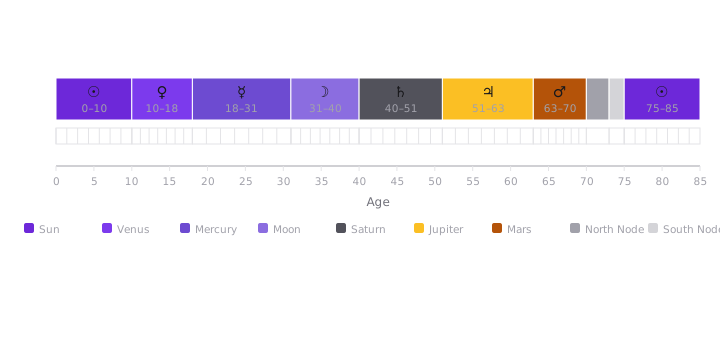
Western astrology predominantly utilizes the seasonal Tropical zodiac and quadrant house systems (e.g., Placidus or Whole Sign), prioritizing angular geometric aspects. Vedic Jyotish employs the Sidereal zodiac, equal-house or Bhava divisions, 27 lunar Nakshatras, harmonic divisional vargas (especially Navamsha D9), and the 120-year Vimshottari Dasha system calculated from the natal Moon.
Diagnostic Chart Case Study
For a single birth chart, Western astrology explores the native's psychological complexes, relational attachment styles, and vocational archetypes. In Vedic Jyotish, an astrologer evaluates the strength of the 10th lord in divisional charts (Navamsha D9 and Dashamsha D10) alongside the current Jupiter Mahadasha and Mercury Antardasha to pinpoint exact years of corporate promotion and material windfalls.
Practical Synthesis and Reading Tips
Consult each tradition according to your analytical need. For psychological integration, exploring emotional archetypes, and understanding personality dynamics, Western astrology offers extraordinary depth. For structural forecasting, critical life transitions, and karmic milestones, Vedic Jyotish is built for chronological precision.
Life Context and Self-Awareness
Destiny weaves together both immutable causal currents and conscious choice. Using Vedic astrology to recognize your karmic boundaries, while employing Western archetypes to elevate subjective consciousness, allows you to navigate gracefully between fate and free will.