Ek: Yeniden Hesaplanabilir Matematiksel Tablolar ve Çıkarımlar
Matematiksel ek, gezegen periyotlarını, Fuxi ikili kodlarını, dekan-tarot eşleşmelerini ve 78 kartlık kombinatoryel durum uzayını bağımsız denetim için sunar.
Introduction to Recomputable Tables and Mathematical Auditability
Scientific research demands transparency, auditability, and independent recomputability. This appendix brings together the foundational constants, algebraic permutation matrices, combinatorial probability figures, and algorithmic lookup tables referenced throughout the monograph. Every table includes clear derivation methods and citations, ensuring third-party researchers can replicate all calculations.
Table A-1: Five Planets: Periods and Classical Chinese Correspondences
Constants determined from NASA Planetary Fact Sheets: Mercury (Chenxing / Water) sidereal period 88 days, synodic period 116 days; Venus (Taibai / Metal) sidereal 225 days, synodic 584 days; Mars (Yinghuo / Fire) sidereal 687 days, synodic 780 days; Jupiter (Suixing / Wood) sidereal 11.86 years, synodic 399 days; Saturn (Zhenxing / Earth) sidereal 29.46 years, synodic 378 days. Sidereal periods lock chronological cycles, while synodic periods pace observational omen windows.
Table A-2: Bagua Three-Bit Binary Values (Fuxi Order)
Following the Bouvet-Leibniz binary interpretation (yang = 1, yin = 0, read top-down): Qian 111 corresponds to decimal 7, Dui 110 to 6, Li 101 to 5, Zhen 100 to 4, Xun 011 to 3, Kan 010 to 2, Gen 001 to 1, and Kun 000 to 0. Shao Yong's circular and square arrangements illustrate ascending and descending binary progressions, proving 64 hexagrams exhaust the 6-bit state space.
Table A-3 and A-3b/c: Book T Tarot Correspondences and Thirty-Six Decans
Sourced from the 1888 Hermetic Order of the Golden Dawn Book T manuscripts: 0 Fool corresponds to Aether/Air, 1 Magician to Mercury, 2 High Priestess to Moon, 3 Empress to Venus, 4 Emperor to Aries, through 21 World to Saturn. Egyptian thirty-six decans divide the zodiac into 10-degree intervals, providing a recursive 3x12 subdivision identical to astronomical timekeeping practices across Persia and Hellenistic Greece.
Table A-4a/b/c: Tarot 78-Card Combinatorial State Spaces and Permutations
Across 78 cards with independent upright/reversed orientations: 1-card draw yields 156 states; 3-card spread yields 456,456 permutations (3,651,648 with orientations); 5-card spread yields 2,533,330,800 permutations (8.10x10¹⁰ with orientations); 10-card Celtic Cross spans 4.67x10²¹ states. Popular literature erroneously applying combinations underestimates spread complexity by 3,628,800-fold (10!). Exact probabilities: 3-card contains major arcana: 63.56%; 5-card: 81.91%; 10-card: 97.17%.
Figure A-1: Liuren Cosmic Board Information Flow and Modular Lookup
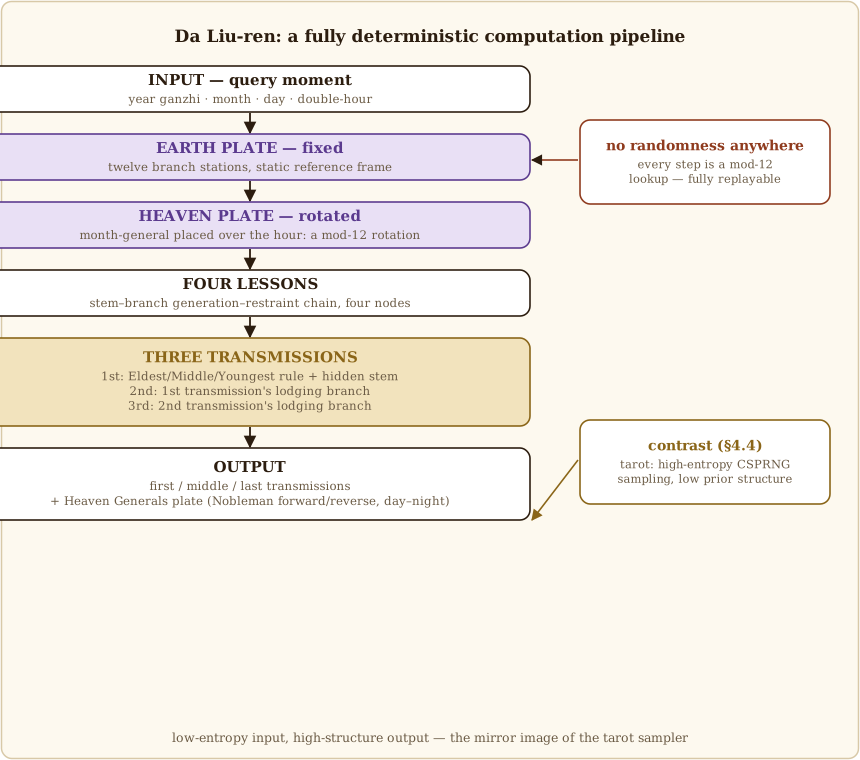
The ancient Chinese Liuren cosmic board maps celestial mechanics through rotating heaven and earth plates. The derivation executes modular arithmetic: solar month plus hour establishes the heaven plate; Four Lessons identify elemental relationships; Three Transmissions extract initial, middle, and final pivots. The algorithm functions as a deterministic finite state machine with zero random sources.
Figure A-2: Sexagenary Sixty-Cycle Congruence Generation Rule
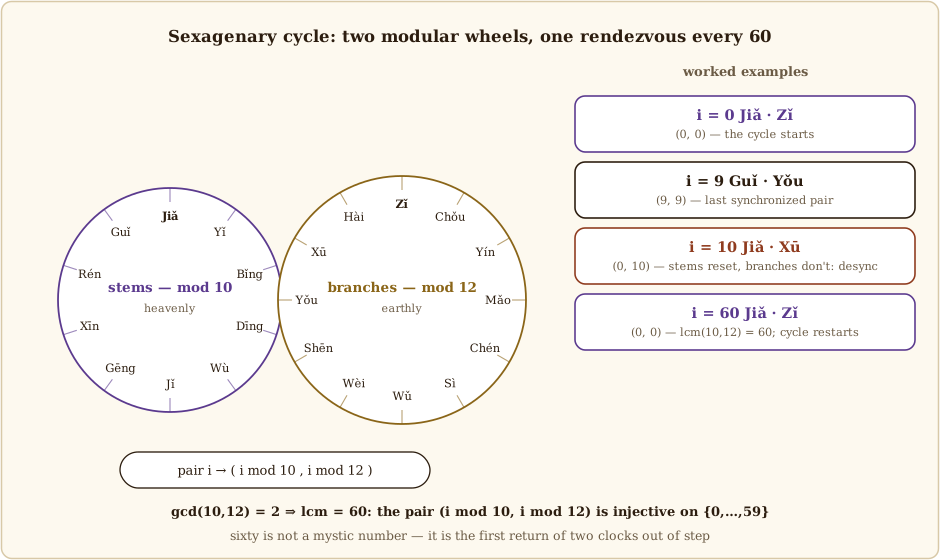
Ten heavenly stems (mod 10) and twelve earthly branches (mod 12) pair via i ↦ (i mod 10, i mod 12). Because gcd(10, 12) = 2 and lcm(10, 12) = 60, the pairs remain distinct across steps 0 through 59, closing precisely at step 60. This simple algebraic rule demonstrates the mathematical inevitability of the sixty-year calendrical cycle without arbitrary empirical intervention.
Ek Kaynakça I: Klasik Astronomi ve Arkeolojik Kaynaklar
Temel astronomik hesaplamalar ve arkeolojik kaynak metinleri: Bretagnon & Francou (1988) VSOP87 gezegen teorileri; Espenak & Meeus (2006) NASA Beş Bin Yıllık Tutulma Kataloğu (-1999'dan +3000'e); Hunger & Steele (2019) Babil astronomik risalesi MUL.APIN (M.Ö. 1000 civarı); Justeson & Lowry (2025) Maya Dresden Kodeksi Tutulma Tablosu (Science Advances 11(43), 1.655 ay döngüsünde 69 istasyon); Li et al. (2026) Kehanet kemiği yazıtları veri seti OBIMD (Scientific Data, 10.077 sürtme kopyası); Neugebauer (1955, 1975) Astronomik Çivi Yazılı Metinler ve Antik Matematiksel Astronomi Tarihi; Sivin (1969, 2009) Antik Çin Astronomisinde Evren ve Hesaplama ile Shoushi Takvimi; Steele (2000) Tutulma gözlemleri; Batlamyus (1940) Tetrabiblos (Loeb).
Ek Kaynakça II: Çin Kehaneti, Yakın Doğu Astrolojisi ve İkili Sistem Tarihi
Karşılaştırmalı matematiksel modeller ve temel metinler: Cullen (2011) Mawangdui Beş Gezegen Kehanetleri Wu xing zhan (SCIAMVS 12: 193-249); Ho Peng-Yoke (2003) Chinese Mathematical Astrology (RoutledgeCurzon); Needham (1959) Science and Civilisation in China, Cilt 3; Pingree (1973) Erken Hint Astronomisinin Mezopotamya Kökeni; Sun & Kistemaker (1997) Han Döneminde Çin Göğü; Hanedanlık tarihleri (Shiji, Hanshu, Yuanshi); Bouché-Leclercq (1899) L'astrologie grecque; Cauville (1997) Dendera Zodyakı; Catalogus Codicum Astrologorum Graecorum (CCAG); Rochberg (2004, 2010) The Heavenly Writing & In the Path of the Moon; West (1880) Pehlevi Metinleri: Bundahishn; Leibniz (1703) İkili Aritmetiğin Açıklaması; Ryan (1996) Leibniz'in İkili Sistemi ve Shao Yong'un Yijing'i; Schumann (2021) Mezopotamya Kehanetlerinde Boole Mantığı.
Ek Kaynakça III: Tarot Tarihi, İstatistiksel Doğrulama ve Ön Tescil Protokolü
Örnekleme mekanizmaları tarihi ve deneysel istatistik metodolojisi: Dummett (1980) The Game of Tarot (kartların 15. yüzyıl Kuzey İtalya saray kökenini belgeleyen standart akademik çalışma); Dummett & McLeod (2004) A History of the Occult Tarot; Mathers (1888) Book T - The Tarot (78 kartı astrolojik koordinatlara bağlayan Golden Dawn el yazması); Bates et al. (2015) lme4 ile doğrusal karma modeller; Cohen (1988) Davranış Bilimleri İçin İstatistiksel Güç Analizi (eşleştirilmiş tasarım: d=0.4, alfa=0.05, güç=0.80); Knuth (1997) The Art of Computer Programming (Fisher-Yates karıştırma algoritması); Rammstedt & John (2007) BFI-10 Beş Faktör Envanteri; Tobacyk (2004) Revize Paranormal İnanç Ölçeği. Ön tescilli deney protokolü ve ki-kare uyum testi (serbestlik derecesi 77).
Co-Authorship Attribution and Copyright Notice
This monograph is jointly researched and published by vaticinator.net and astrostarcheck.com as co-authors. All chapters, illustrations, mathematical formulas, and data models remain the intellectual property of both platforms. All rights reserved. Reproduction, distribution, mirroring, commercial exploitation, or unauthorized machine-learning training without prior written consent is strictly prohibited.
Sık Sorulanlar
Why must positional tarot spreads use permutations (P) instead of combinations (C)?
Because spread positions (such as past, present, future) possess distinct contextual definitions. Drawing the exact same cards in a different sequence produces an entirely different interpretive outcome, making order decisive.
Why does the sixty-year sexagenary cycle terminate at 60 steps rather than 120?
Because 10 and 12 share a greatest common divisor of 2. By the Chinese Remainder Theorem and elementary number theory, their least common multiple lcm(10, 12) equals 60, after which the modular sequences necessarily repeat.
How does the Liuren cosmic board connect to modern computing concepts?
The Liuren system is a geometric finite state machine. Plate rotations correspond to modular 12 addition, and extracting transmissions corresponds to strict conditional branching and matrix lookup, without supernatural randomness.
Kaynaklar ve ileri okuma
Bu sayfadaki astronomik konumlar ve yorum kuralları aşağıdaki eserlerle karşılaştırılır.
- Swiss Ephemeris (Astrodienst) (tüm harita hesaplamalarının dayandığı efemeris kütüphanesi)
- Swiss Ephemeris programmer's documentation (hesaplama parametreleri ve API başvurusu)
- Introduction to the Tetrabiblos (Skyscript)
- Hellenistic astrology (Helenistik uygulamaya dair tarihsel ve teknik kaynaklar)