付録:再計算可能な数表と東西文明の数理的導出
数理付録は五惑星周期と五行の対照表、伏羲八卦の3ビット二進法、36旬星とタロット対応、78枚順列空間を収録し、公開再計算可能な数学的根拠を提供します。
Introduction to Recomputable Tables and Mathematical Auditability
Scientific research demands transparency, auditability, and independent recomputability. This appendix brings together the foundational constants, algebraic permutation matrices, combinatorial probability figures, and algorithmic lookup tables referenced throughout the monograph. Every table includes clear derivation methods and citations, ensuring third-party researchers can replicate all calculations.
Table A-1: Five Planets: Periods and Classical Chinese Correspondences
Constants determined from NASA Planetary Fact Sheets: Mercury (Chenxing / Water) sidereal period 88 days, synodic period 116 days; Venus (Taibai / Metal) sidereal 225 days, synodic 584 days; Mars (Yinghuo / Fire) sidereal 687 days, synodic 780 days; Jupiter (Suixing / Wood) sidereal 11.86 years, synodic 399 days; Saturn (Zhenxing / Earth) sidereal 29.46 years, synodic 378 days. Sidereal periods lock chronological cycles, while synodic periods pace observational omen windows.
Table A-2: Bagua Three-Bit Binary Values (Fuxi Order)
Following the Bouvet-Leibniz binary interpretation (yang = 1, yin = 0, read top-down): Qian 111 corresponds to decimal 7, Dui 110 to 6, Li 101 to 5, Zhen 100 to 4, Xun 011 to 3, Kan 010 to 2, Gen 001 to 1, and Kun 000 to 0. Shao Yong's circular and square arrangements illustrate ascending and descending binary progressions, proving 64 hexagrams exhaust the 6-bit state space.
Table A-3 and A-3b/c: Book T Tarot Correspondences and Thirty-Six Decans
Sourced from the 1888 Hermetic Order of the Golden Dawn Book T manuscripts: 0 Fool corresponds to Aether/Air, 1 Magician to Mercury, 2 High Priestess to Moon, 3 Empress to Venus, 4 Emperor to Aries, through 21 World to Saturn. Egyptian thirty-six decans divide the zodiac into 10-degree intervals, providing a recursive 3x12 subdivision identical to astronomical timekeeping practices across Persia and Hellenistic Greece.
Table A-4a/b/c: Tarot 78-Card Combinatorial State Spaces and Permutations
Across 78 cards with independent upright/reversed orientations: 1-card draw yields 156 states; 3-card spread yields 456,456 permutations (3,651,648 with orientations); 5-card spread yields 2,533,330,800 permutations (8.10x10¹⁰ with orientations); 10-card Celtic Cross spans 4.67x10²¹ states. Popular literature erroneously applying combinations underestimates spread complexity by 3,628,800-fold (10!). Exact probabilities: 3-card contains major arcana: 63.56%; 5-card: 81.91%; 10-card: 97.17%.
Figure A-1: Liuren Cosmic Board Information Flow and Modular Lookup
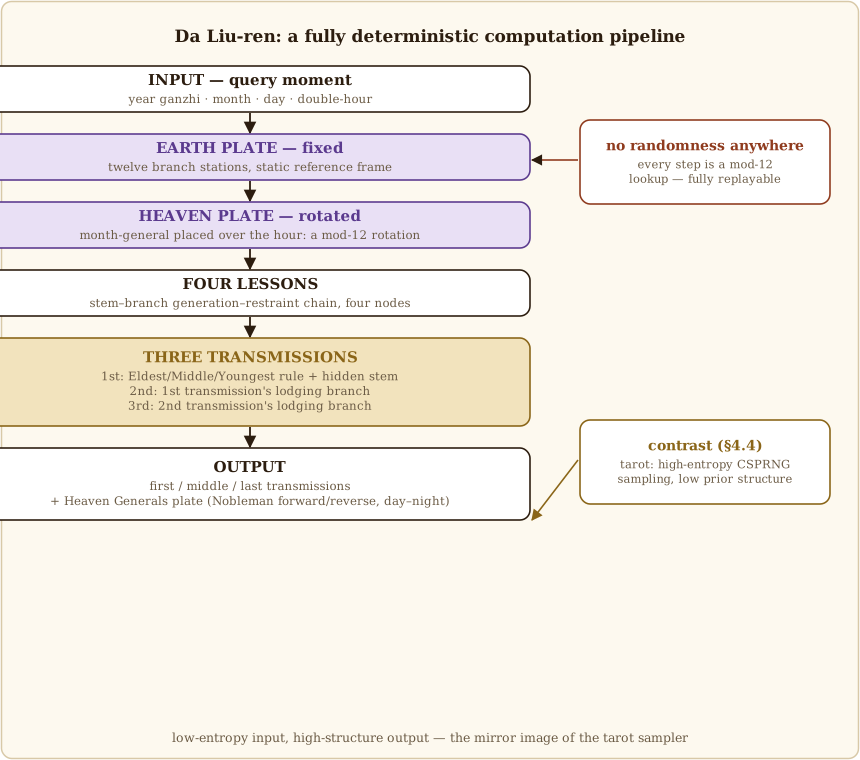
The ancient Chinese Liuren cosmic board maps celestial mechanics through rotating heaven and earth plates. The derivation executes modular arithmetic: solar month plus hour establishes the heaven plate; Four Lessons identify elemental relationships; Three Transmissions extract initial, middle, and final pivots. The algorithm functions as a deterministic finite state machine with zero random sources.
Figure A-2: Sexagenary Sixty-Cycle Congruence Generation Rule
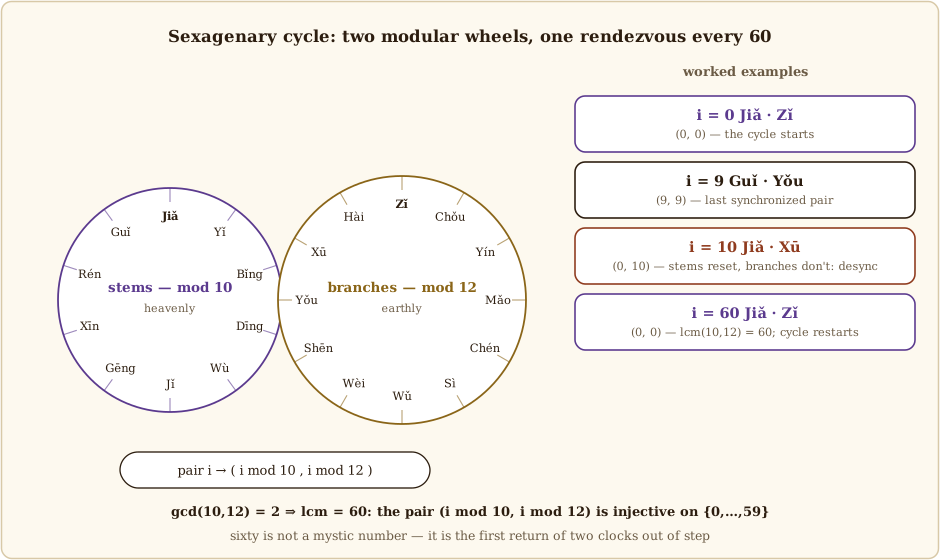
Ten heavenly stems (mod 10) and twelve earthly branches (mod 12) pair via i ↦ (i mod 10, i mod 12). Because gcd(10, 12) = 2 and lcm(10, 12) = 60, the pairs remain distinct across steps 0 through 59, closing precisely at step 60. This simple algebraic rule demonstrates the mathematical inevitability of the sixty-year calendrical cycle without arbitrary empirical intervention.
付録参考文献一:古代数理天文学と出土文献の基礎史料
天文学的計算および出土文献の校訂基準史料:Bretagnon & Francou (1988) VSOP87惑星理論;Espenak & Meeus (2006) NASA5000年日食典(紀元前1999〜紀元後3000);Hunger & Steele (2019) バビロニア天文提要 MUL.APIN(前1000年頃の66星表と影表);Justeson & Lowry (2025) マヤ・ドレスデン絵文書の日食表(Science Advances 11(43)、69観測所と1,655朔望月周期);Li et al. (2026) 甲骨文字多層データセット OBIMD(Scientific Data、拓本10,077件);Neugebauer (1955, 1975) バビロニア楔形文字天文学および古代数理天文学史;Sivin (1969, 2009) 中国天文学における宇宙計算と"授時暦"招差術;Steele (2000) 古代天文学者の食観測;Ptolemy (1940) プトレマイオス"四書の書"(テトラビブロス、Loeb版)。
付録参考文献二:東洋数術・西アジア占星術および二進法の比較史料
数理モデル比較および文献史料:Cullen (2011) 馬王堆帛書"五星占"全訳と数理考(SCIAMVS 12: 193–249);Ho Peng-Yoke (2003) 宋代司天監の三式数学(Chinese Mathematical Astrology, RoutledgeCurzon);Needham (1959) "中国の科学と文明"第3巻;Pingree (1973) インド数理天文学のメソポタミア起源論;Sun & Kistemaker (1997) 漢代の星空と二十八宿の実測;中華書局校訂本"史記·天官書""漢書·天文志""元史·暦志";Bouché-Leclercq (1899) ギリシア占星術史;Cauville (1997) デンデラ黄道の学術的解読;ギリシア占星術写本目録(CCAG 1898–1953);Rochberg (2004, 2010) バビロニア天象占いと月の道文脈;West (1880) パフラヴィー語文献"ブンダヒシュン";Leibniz (1703) 二進法算術の解説とブーヴェ神父との往復書簡;Ryan (1996) ライプニッツの二進法と邵雍の易経(Philosophy East and West);Schumann (2021) バビロニア占辞のブール代数論理。
付録参考文献三:タロット史・統計的検証および事前登録実験規範
サンプリング機構史および計量統計学的検証文献:Dummett (1980) "タロットの歴史:フェラーラからソルトレイクシティへ"(15世紀北イタリア宮廷起源を立証した標準的学術考証);Dummett & McLeod (2004) "オカルト・タロットの歴史 1870–1960";Mathers (1888) "Book T - タロット"(黄金の夜明け団による78枚の天文座標対応手稿);Bates et al. (2015) lme4による線形混合効果モデル;Cohen (1988) 行動科学のための統計的検出力分析(対応のある設計 d=0.4, α=0.05, power=0.80);Knuth (1997) "準数値アルゴリズム"(Fisher–Yatesシャッフル);Rammstedt & John (2007) BFI-10短縮版ビッグファイブ尺度;Tobacyk (2004) 改訂版超常現象信念尺度。全二重盲検対応実験事前登録およびカイ二乗均一性検定(自由度77)を完全公開。
Co-Authorship Attribution and Copyright Notice
This monograph is jointly researched and published by vaticinator.net and astrostarcheck.com as co-authors. All chapters, illustrations, mathematical formulas, and data models remain the intellectual property of both platforms. All rights reserved. Reproduction, distribution, mirroring, commercial exploitation, or unauthorized machine-learning training without prior written consent is strictly prohibited.
よくある質問
Why must positional tarot spreads use permutations (P) instead of combinations (C)?
Because spread positions (such as past, present, future) possess distinct contextual definitions. Drawing the exact same cards in a different sequence produces an entirely different interpretive outcome, making order decisive.
Why does the sixty-year sexagenary cycle terminate at 60 steps rather than 120?
Because 10 and 12 share a greatest common divisor of 2. By the Chinese Remainder Theorem and elementary number theory, their least common multiple lcm(10, 12) equals 60, after which the modular sequences necessarily repeat.
How does the Liuren cosmic board connect to modern computing concepts?
The Liuren system is a geometric finite state machine. Plate rotations correspond to modular 12 addition, and extracting transmissions corresponds to strict conditional branching and matrix lookup, without supernatural randomness.
出典と参考文献
本ページの天文座標と解釈の規則は、以下の文献と照合しています。
- Swiss Ephemeris (Astrodienst) (当サイトの天体計算すべてに使う暦計算ライブラリ)
- Swiss Ephemeris programmer's documentation (計算パラメータとAPIの仕様)
- Introduction to the Tetrabiblos (Skyscript)
- Hellenistic astrology (ヘレニズム期占星術の歴史的・技術的資料)