Приложение: Пересчитываемые математические таблицы и выводы
Математическое приложение содержит сопоставления периодов планет, двоичные триграммы Фуси, деканы Таро и комбинаторные пространства 78 карт для открытой проверки.
Introduction to Recomputable Tables and Mathematical Auditability
Scientific research demands transparency, auditability, and independent recomputability. This appendix brings together the foundational constants, algebraic permutation matrices, combinatorial probability figures, and algorithmic lookup tables referenced throughout the monograph. Every table includes clear derivation methods and citations, ensuring third-party researchers can replicate all calculations.
Table A-1: Five Planets: Periods and Classical Chinese Correspondences
Constants determined from NASA Planetary Fact Sheets: Mercury (Chenxing / Water) sidereal period 88 days, synodic period 116 days; Venus (Taibai / Metal) sidereal 225 days, synodic 584 days; Mars (Yinghuo / Fire) sidereal 687 days, synodic 780 days; Jupiter (Suixing / Wood) sidereal 11.86 years, synodic 399 days; Saturn (Zhenxing / Earth) sidereal 29.46 years, synodic 378 days. Sidereal periods lock chronological cycles, while synodic periods pace observational omen windows.
Table A-2: Bagua Three-Bit Binary Values (Fuxi Order)
Following the Bouvet-Leibniz binary interpretation (yang = 1, yin = 0, read top-down): Qian 111 corresponds to decimal 7, Dui 110 to 6, Li 101 to 5, Zhen 100 to 4, Xun 011 to 3, Kan 010 to 2, Gen 001 to 1, and Kun 000 to 0. Shao Yong's circular and square arrangements illustrate ascending and descending binary progressions, proving 64 hexagrams exhaust the 6-bit state space.
Table A-3 and A-3b/c: Book T Tarot Correspondences and Thirty-Six Decans
Sourced from the 1888 Hermetic Order of the Golden Dawn Book T manuscripts: 0 Fool corresponds to Aether/Air, 1 Magician to Mercury, 2 High Priestess to Moon, 3 Empress to Venus, 4 Emperor to Aries, through 21 World to Saturn. Egyptian thirty-six decans divide the zodiac into 10-degree intervals, providing a recursive 3x12 subdivision identical to astronomical timekeeping practices across Persia and Hellenistic Greece.
Table A-4a/b/c: Tarot 78-Card Combinatorial State Spaces and Permutations
Across 78 cards with independent upright/reversed orientations: 1-card draw yields 156 states; 3-card spread yields 456,456 permutations (3,651,648 with orientations); 5-card spread yields 2,533,330,800 permutations (8.10x10¹⁰ with orientations); 10-card Celtic Cross spans 4.67x10²¹ states. Popular literature erroneously applying combinations underestimates spread complexity by 3,628,800-fold (10!). Exact probabilities: 3-card contains major arcana: 63.56%; 5-card: 81.91%; 10-card: 97.17%.
Figure A-1: Liuren Cosmic Board Information Flow and Modular Lookup
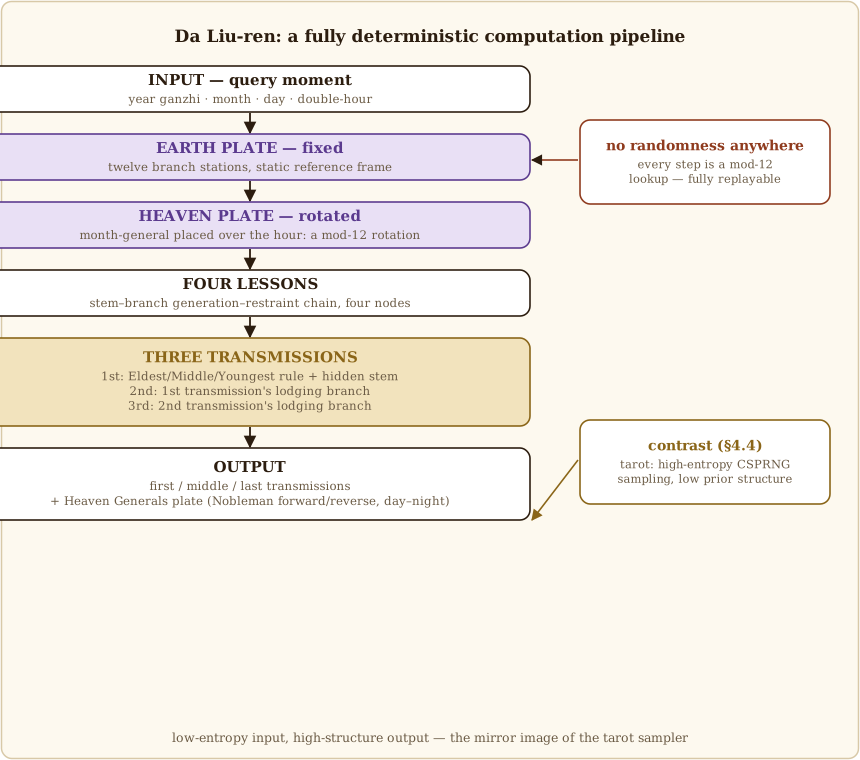
The ancient Chinese Liuren cosmic board maps celestial mechanics through rotating heaven and earth plates. The derivation executes modular arithmetic: solar month plus hour establishes the heaven plate; Four Lessons identify elemental relationships; Three Transmissions extract initial, middle, and final pivots. The algorithm functions as a deterministic finite state machine with zero random sources.
Figure A-2: Sexagenary Sixty-Cycle Congruence Generation Rule
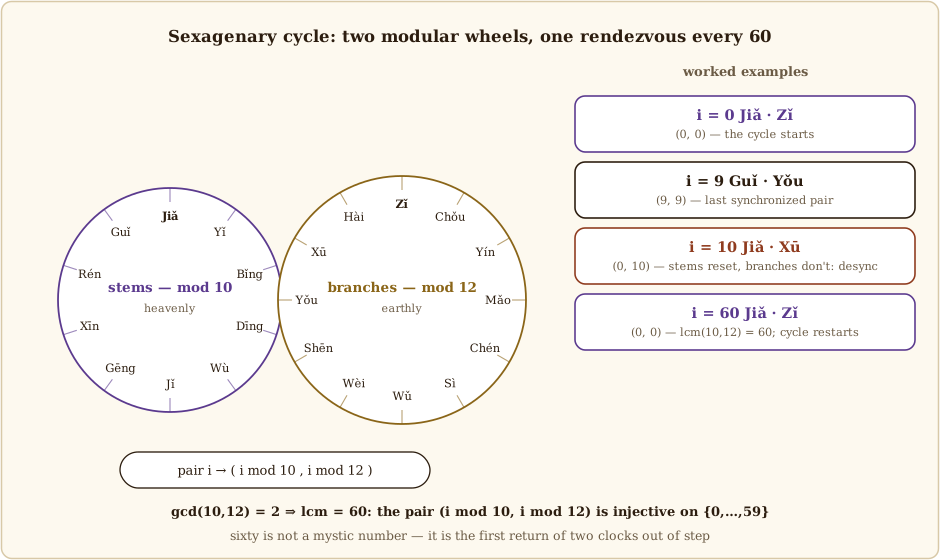
Ten heavenly stems (mod 10) and twelve earthly branches (mod 12) pair via i ↦ (i mod 10, i mod 12). Because gcd(10, 12) = 2 and lcm(10, 12) = 60, the pairs remain distinct across steps 0 through 59, closing precisely at step 60. This simple algebraic rule demonstrates the mathematical inevitability of the sixty-year calendrical cycle without arbitrary empirical intervention.
Библиография приложения I: Древняя астрономия и археологические источники
Базовые астрономические расчеты и археологические памятники: Bretagnon & Francou (1988) теории планетных возмущений VSOP87; Espenak & Meeus (2006) Канон затмений NASA за пять тысячелетий (от −1999 до +3000); Hunger & Steele (2019) Вавилонский трактат MUL.APIN (ок. 1000 г. до н. э.); Justeson & Lowry (2025) Таблица затмений Дрезденского кодекса майя (Science Advances 11(43), 69 станций в цикле 1655 лунаций); Li et al. (2026) Мультимодальный датасет гадательных надписей OBIMD (Scientific Data, 10 077 эстампажей); Neugebauer (1955, 1975) Астрономические клинописные тексты и История древней математической астрономии; Sivin (1969, 2009) Космос и вычисления в древнем Китае и календарь Шоуши; Steele (2000) Наблюдения затмений; Птолемей (1940) Тетрабиблос (Loeb).
Библиография приложения II: Китайская прогностика, ближневосточная астрология и история двоичной системы
Сравнительные математические модели и источники: Cullen (2011) Трактат У син чжань из Мавандуй (SCIAMVS 12: 193-249); Ho Peng-Yoke (2003) Китайская математическая астрология (RoutledgeCurzon); Needham (1959) Наука и цивилизация в Китае, том 3; Pingree (1973) Месопотамское происхождение индийской астрономии; Sun & Kistemaker (1997) Китайское небо эпохи Хань; Династийные хроники (Ши цзи, Хань шу, Юань ши); Bouché-Leclercq (1899) Греческая астрология; Cauville (1997) Дендерский зодиак; Каталог греческих астрологических рукописей (CCAG); Rochberg (2004, 2010) Небесная письменность и Путем Луны; West (1880) Пехлевийский трактат Бундахишн; Leibniz (1703) Объяснение двоичной арифметики; Ryan (1996) Двоичная система Лейбница и Книга Перемен Шао Юна; Schumann (2021) Логика вавилонских знамений.
Библиография приложения III: История Таро, статистический анализ и протокол пререгистрации
История случайных механизмов и эмпирические статистические методы: Dummett (1980) The Game of Tarot (академическое исследование североитальянского придворного происхождения карт XV века); Dummett & McLeod (2004) A History of the Occult Tarot; Mathers (1888) Book T - The Tarot (манускрипт Золотой Зари с астрономической привязкой 78 карт); Bates et al. (2015) Линейные смешанные модели в lme4; Cohen (1988) Анализ статистической мощности для поведенческих наук (дизайн с сопряженными парами: d=0.4, alpha=0.05, power=0.80); Knuth (1997) Искусство программирования (алгоритм тасования Фишера-Йейтса); Rammstedt & John (2007) Опросник BFI-10; Tobacyk (2004) Шкала паранормальных верований. Протокол пререгистрации, криптографический аудит CSPRNG и критерий хи-квадрат (df=77).
Co-Authorship Attribution and Copyright Notice
This monograph is jointly researched and published by vaticinator.net and astrostarcheck.com as co-authors. All chapters, illustrations, mathematical formulas, and data models remain the intellectual property of both platforms. All rights reserved. Reproduction, distribution, mirroring, commercial exploitation, or unauthorized machine-learning training without prior written consent is strictly prohibited.
Частые вопросы
Why must positional tarot spreads use permutations (P) instead of combinations (C)?
Because spread positions (such as past, present, future) possess distinct contextual definitions. Drawing the exact same cards in a different sequence produces an entirely different interpretive outcome, making order decisive.
Why does the sixty-year sexagenary cycle terminate at 60 steps rather than 120?
Because 10 and 12 share a greatest common divisor of 2. By the Chinese Remainder Theorem and elementary number theory, their least common multiple lcm(10, 12) equals 60, after which the modular sequences necessarily repeat.
How does the Liuren cosmic board connect to modern computing concepts?
The Liuren system is a geometric finite state machine. Plate rotations correspond to modular 12 addition, and extracting transmissions corresponds to strict conditional branching and matrix lookup, without supernatural randomness.
Источники и дополнительная литература
Астрономические координаты и правила толкования на этой странице сверены с перечисленными работами.
- Swiss Ephemeris (Astrodienst) (библиотека эфемерид, на которой построены все расчёты карт)
- Swiss Ephemeris programmer's documentation (параметры расчёта и описание API)
- Introduction to the Tetrabiblos (Skyscript)
- Hellenistic astrology (исторические и технические материалы по эллинистической практике)